'Dark stars' could be the seeds of supermassive black holes, scientists say
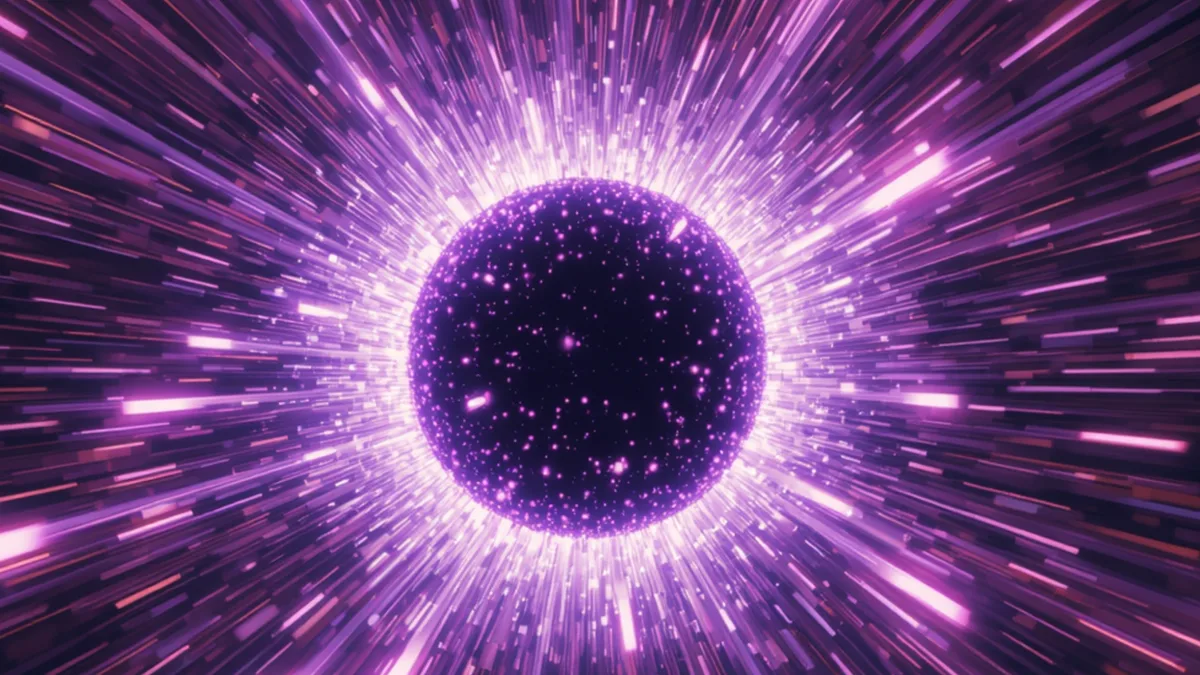
A mysterious hum of gravitational waves that fills the cosmos may be the echo of "dark stars" that served as the seeds of the first supermassive black holes.
These low-frequency gravitational waves were detected back in 2023 using an array of cosmic lighthouses, or pulsars , in a so-called " pulsar timing array.
" Pulsars are neutron stars that spin rapidly and regularly while blasting out collimated beams of radiation from their poles that can be used to detect tiny fluctuations in space and time.
Such fluctuations are caused by the gravitational waves, or ripples in spacetime.
For a long time, the source of this particular low-frequency gravitational wave background has been somewhat shrouded in mystery, but scientists have hoped that they may be encoded with the secrets of the universe as it was around 13 billion years ago.
Indeed, the team behind this research believes this hum of spacetime ripples could help explain how supermassive black holes grew so rapidly before the universe was even a billion years old.
They link this solution to hypothetical supermassive "dark stars" that may have collapsed and died in the early universe to birth massive black hole seeds , giving supermassive black hole growth a head start.
"Dark stars were originally proposed as objects that might be seen directly at cosmic dawn," Ilie said.
"This work points to a completely different way of testing their possible role in cosmic history," team member Cosmin Ilie of Colgate University said in a statement.
"Their descendants could leave a gravitational-wave imprint that persists all the way to the present-day universe." Cosmic clocks and collapsing Dark Stars Pulsar timing arrays detect gravitational waves when their passage squashes and stretches space as the waves ripple past them, causing tiny delays in the pulsars' beams of radiation reaching Earth.
Detecting a gravitational wave background , however, required monitoring pulsar timing arrays for many years.
"Pulsar timing arrays are usually thought of as probes of supermassive black-hole binaries in the relatively recent universe," Ilie said.
"What our work shows is that the signal may also contain information about how the ancestors of those black holes formed at cosmic dawn.
"In that sense, gravitational waves observed today could provide a new window onto the birth of the first supermassive black holes." An illustration shows a neutron star at the heart of a pulsar and its strong magnetic field beaming radiation from its poles as it spins. (Image credit: Robert Lea (created with Canva)) The currently favored explanation for this background is a cosmic history of binary black holes spiraling together before merging, particularly pairings with combined masses of over 1 billion times the mass of the sun .
5News aggregated this summary from the outlet’s public feed. The full article, with all the context, is on www.space.com — the content belongs to Space.com.