Scientists discover 'chemical starter kit' for life in planetary birthplaces
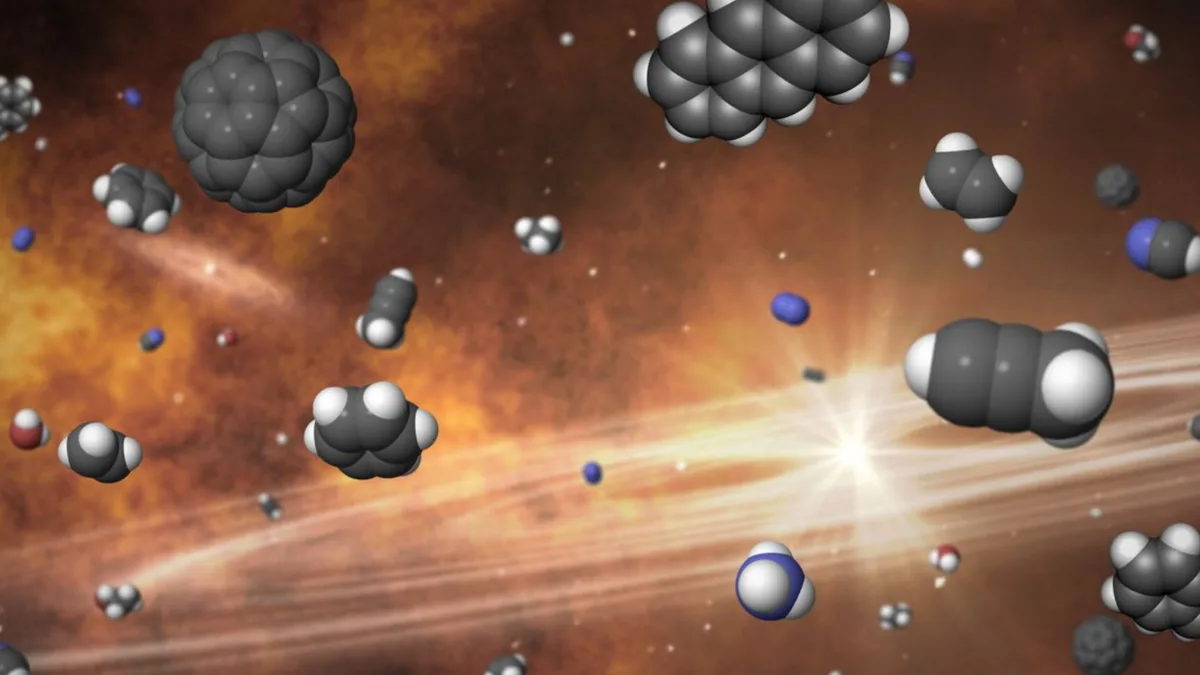
Methanol, coming as part of the 'chemical starter kit' around young stars, has produced some unexpected surprises that could ultimately reveal some of the conditions in which planets and potentially life form around protostars.
The methanol discoveries were made by astronomers using ALMA (the Atacama Large millimeter/submillimeter Array) in the Atacama Desert in Chile, as part of a project called COMPASS (the Complex Organic Molecules in Protostars with ALMA Spectral Surveys).
"Our work provides insight into the complex chemistry of young star systems and is ultimately an important piece of the puzzle in understanding the origin of life," said University of Bern astrophysicist Maria Drozdovskaya, who leads the COMPASS project, in a statement .
Drozdovskaya's multinational team of more than 30 astronomers has been chasing down complex organic molecules, large molecules that include carbon atoms, in the planetary construction yards around eleven young stars.
These molecules form part of the chemical inventory that ultimately builds planets and, perhaps, even life that will one day live on those planets.
Methanol matters Methanol (CH 3 OH) is important because it is highly abundant in star- and planet-forming regions.
In fact, it’s the most abundant complex organic molecule to be found in interstellar space , and is commonly found in planet-forming disks.
Its sheer abundance means that, of all the molecules found around young stars, methanol is the easiest in which to detect different forms where regular hydrogen atoms are replaced by a heavier isotope of hydrogen called deuterium.
How many molecules contain these heavier isotopes is highly dependent upon the conditions in which planets are forming within the disk.
That’s why the COMPASS team used ALMA to search for these forms of methanol in the gas belonging to the planet-forming disks around the 11 nearby low-mass protostars .
The observations have also helped assess the general chemical diversity of these disks.
The Perseus Molecular Cloud home to the protostar IRAS 4A2 (Image credit: NASA/JPL-Caltech) The unexpected discovery of a methanol molecule containing deuterium was made in the planet-forming disk around only one of those 11 stars, namely the young star IRAS 4A2, located about a thousand light-years away in the Perseus Molecular Cloud.
IRAS refers to the Infrared Astronomical Satellite, which was a joint NASA–UK–Netherlands mission launched in 1983 and which first detected this young star as a source of infrared light through the thick gas and dust of the molecular cloud.
The COMPASS team also discovered methanol maser emission from more than half of the 11 protostars, favoring the youngest of the stars.
5News aggregated this summary from the outlet’s public feed. The full article, with all the context, is on www.space.com — the content belongs to Space.com.