Skeleton with 167 fractures discovered at Scottish castle may have been first victim of Edward I's 'War Wolf' trebuchet
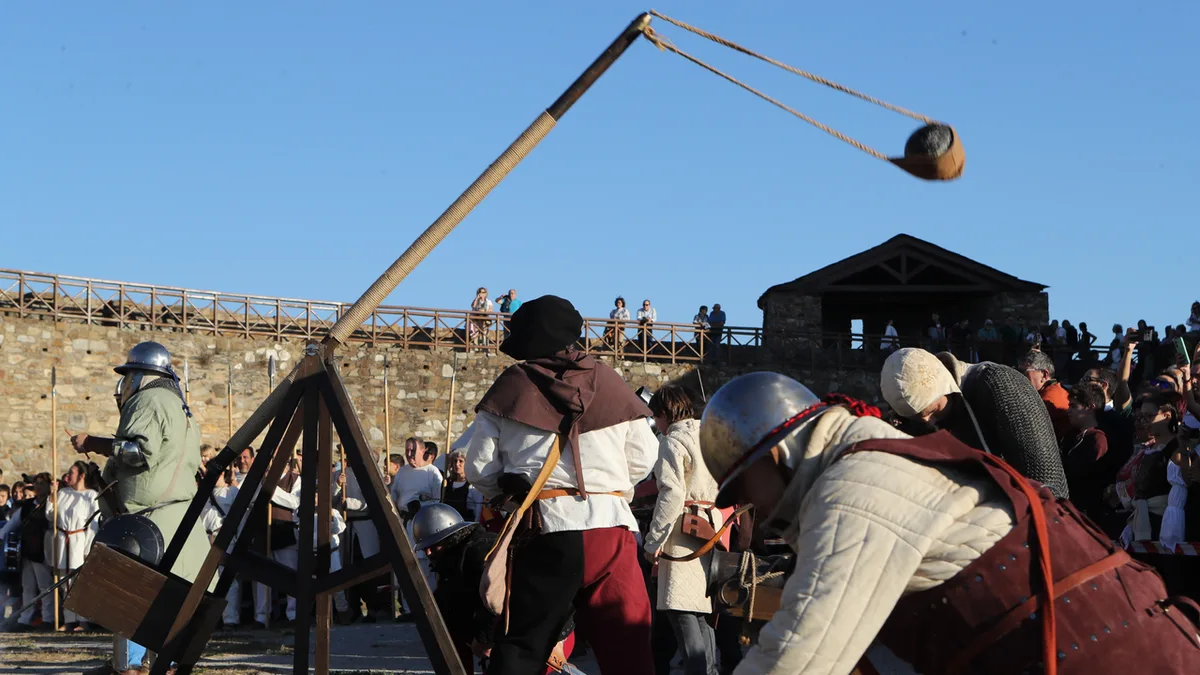
BERLIN — A 14th-century skeleton riddled with fractures may be the oldest known evidence of a death by trebuchet, or "siege engine," new research finds.
The individual, a medieval man whose remains were found inside Stirling Castle in Scotland, may have even been the victim of a famous trebuchet called the "War Wolf" built on the orders of the king of England.
The young man's remains, which researchers call Skeleton 150, were discovered in the Stirling Castle chapel alongside seven other medieval burials in 1997.
In medieval times, the vast majority of people were buried in their parish church cemetery, so finding eight skeletons underneath the royal chapel was a surprise, Jo Buckberry , a biological anthropologist at Bradford University in the U.K., said in a research presentation Aug.
5 at the 25th European Paleopathology Association meeting .
Stirling Castle had an important role in the Wars of Scottish Independence between 1296 and 1357.
Surrounded by steep cliffs, Stirling Castle had a strong defensive position for the Scots to defend themselves as the Kingdom of England was trying to control the Kingdom of Scotland.
All eight medieval skeletons buried in the castle had evidence of trauma inflicted on them around the time of death, including wounds from blunt objects, projectiles and a sharp blade, likely from a sword or knife.
But only Skeleton 150 had a massive number of fractures.
"This is not what I'm used to seeing," Buckberry said in the presentation.
"Could this be a weird form of medieval torture? Did he fall off Stirling Castle and bounce on the way down?" Buckberry and colleagues meticulously studied all 167 fractures in the bones of Skeleton 150.
They discovered that he had sustained 61 separate fractures to his skull and 57 rib fractures, in addition to breaks in his vertebrae, arms and right shoulder.
But most of the damage was to the upper half of the man's body, and the fractures had an unusual zigzag pattern not usually seen in archaeological skeletons.
"I started looking at the forensic literature and the forensic collections," Buckberry said.
5News aggregated this summary from the outlet’s public feed. The full article, with all the context, is on www.livescience.com — the content belongs to Live Science.