Cormac McCarthy’s Midlife Crisis
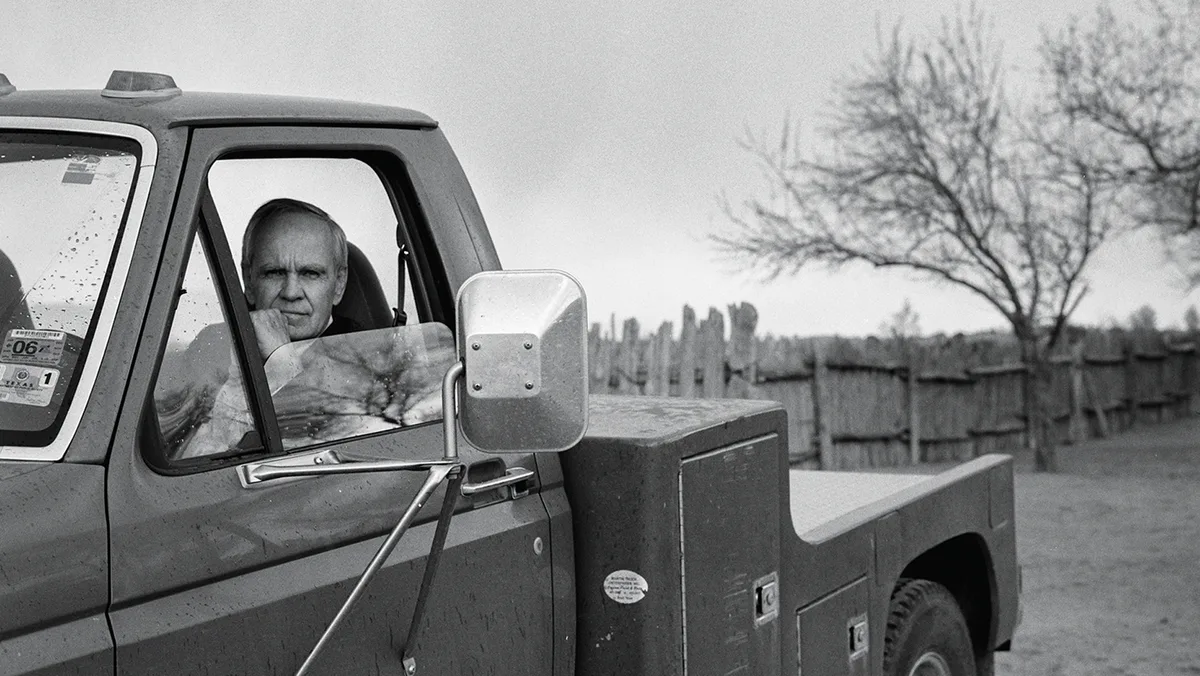
To understand Cormac McCarthy’s midlife crisis, look at America’s landscape.
The fierce writer of biblical prose spent most of his first four decades anchored to Tennessee, a child of Appalachia with a lilting drawl and a regional outlook.
By the early 1970s, he had published three Faulknerian novels—none of which sold well—and was struggling to finish a fourth book that aimed to chronicle his hometown of Knoxville in the way James Joyce had written about Dublin.
McCarthy’s pockets were empty and his second marriage was failing.
His then-wife, Annie DeLisle, recalled that on New Year’s Eve 1973, the year he turned 40, he suddenly announced that it was time for a change.
As a friend put it, “He just walked off and left everything except his boots and his typewriter.” Pointing his truck west on I-40, McCarthy started driving and spent time in Tucson; Santa Fe; and Juárez, Mexico, before settling in El Paso, where he began researching a new novel called Blood Meridian .
Few life swerves are so productive.
The book represented a fresh direction.
Instead of another story set in the forests and shambling urban peripheries of Appalachia, Blood Meridian (1985) was an epic Western.
It ambitiously set out to align the nation’s past with humankind’s age-old thirst for violence: Wolves cull one another, and so do people.
From then on, the fearsome stakes of the West—territorial competition, crime, blood, death—defined McCarthy’s fiction and yielded his strongest work.
His next five novels, including the best sellers All the Pretty Horses (1992) and No Country for Old Men (2005), used desert plains and bleak landscapes to unspool a grim pessimism, shocking readers with stark visions of depravity while preserving the slenderest candlelight of hope: a few good souls carrying the fire.
It was as though Appalachia’s dense woods and city fringes had prevented him from seeing the page clearly.
Out west, there is nothing but sky.
5News aggregated this summary from the outlet’s public feed. The full article, with all the context, is on www.theatlantic.com — the content belongs to The Atlantic.