Archaeologists unearth a medieval nobleman buried with his horse and dog in a rare wooden tomb in Russia
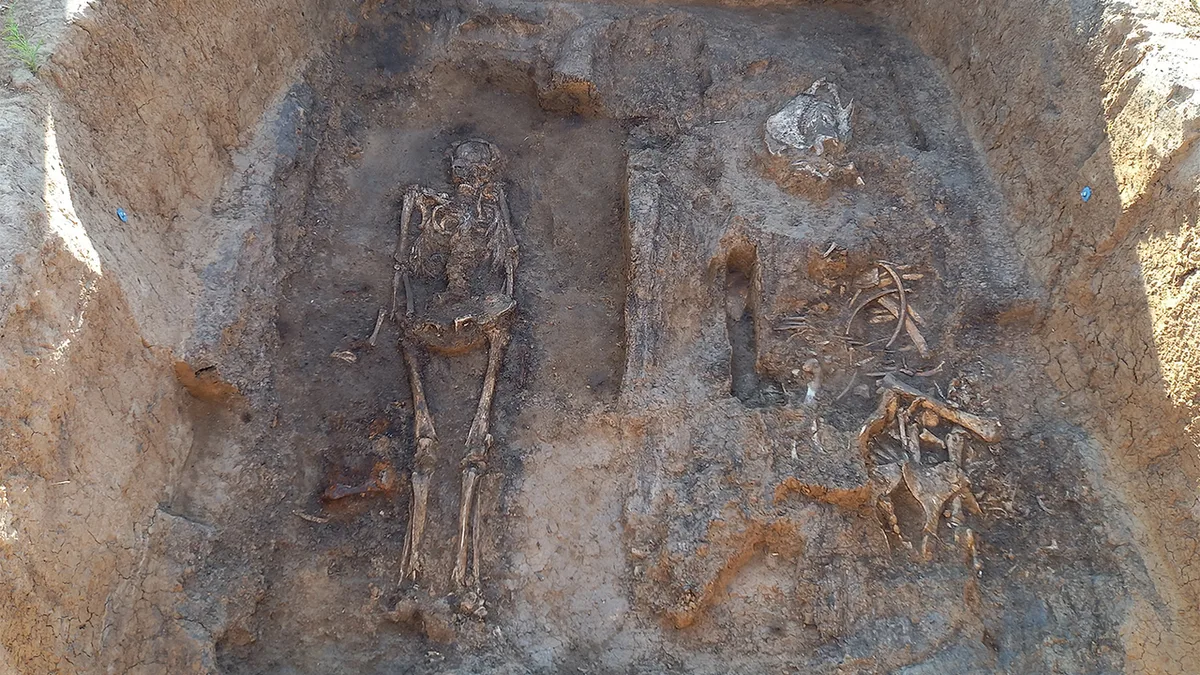
Archaeologists in Russia have unearthed a rare wooden tomb containing the remains of an elite man who was buried with a horse and a dog.
The remarkably preserved burial, which dates to the 10th century, suggests that medieval Russian and Northern European nobility shared funeral customs a millennium ago.
The horseman's burial was discovered unexpectedly this summer during excavations in the medieval cemetery at Gnezdilovo, an archaeological site in Suzdal, Russia, about 137 miles (220 kilometers) northeast of Moscow, according to an Aug.
15 translated statement from the Institute of Archaeology of the Russian Academy of Sciences.
In the late ninth century, what is now western Russia was ruled by the Kievan Rus' (also spelled Kyvian Rus'), a conglomeration of settlements and territories that included Baltic, eastern Slavic and Norse peoples.
By the 10th century, the custom of burying medieval Rus' nobility in underground wooden crypts with a multitude of grave goods was imported from Scandinavia.
The elite man was buried with a silver brooch near his neck. (Image credit: Institute of Archaeology of the Russian Academy of Sciences) But the newfound and remarkably well preserved chamber tomb at Suzdal is a rare and early example of the burial type.
Only 80 other medieval chamber burials have been found across western Russia, according to the statement.
The wooden burial chamber was found about 3.3 feet (1 meter) underground and measured 10.2 by 8.9 feet (3.1 by 2.7 m).
The wooden roof of the chamber had decayed and collapsed onto the deceased in the tomb.
Archaeologists found the skeleton of a man who was about 25 to 35 years old when he died, along with the remains of a horse and a dog.
Also included in the burial were an iron knife, stirrups and other riding gear, as well as a comb made of bone and a battle ax.
The man was buried wearing a garment secured by a silver, horseshoe-shaped brooch near his neck.
The assemblage of the grave goods signifies that the man held high status in his community, according to the statement.
5News aggregated this summary from the outlet’s public feed. The full article, with all the context, is on www.livescience.com — the content belongs to Live Science.