WORDS OF CAUTION: Ramaphosa urges caution on AI advancements, echoing developers
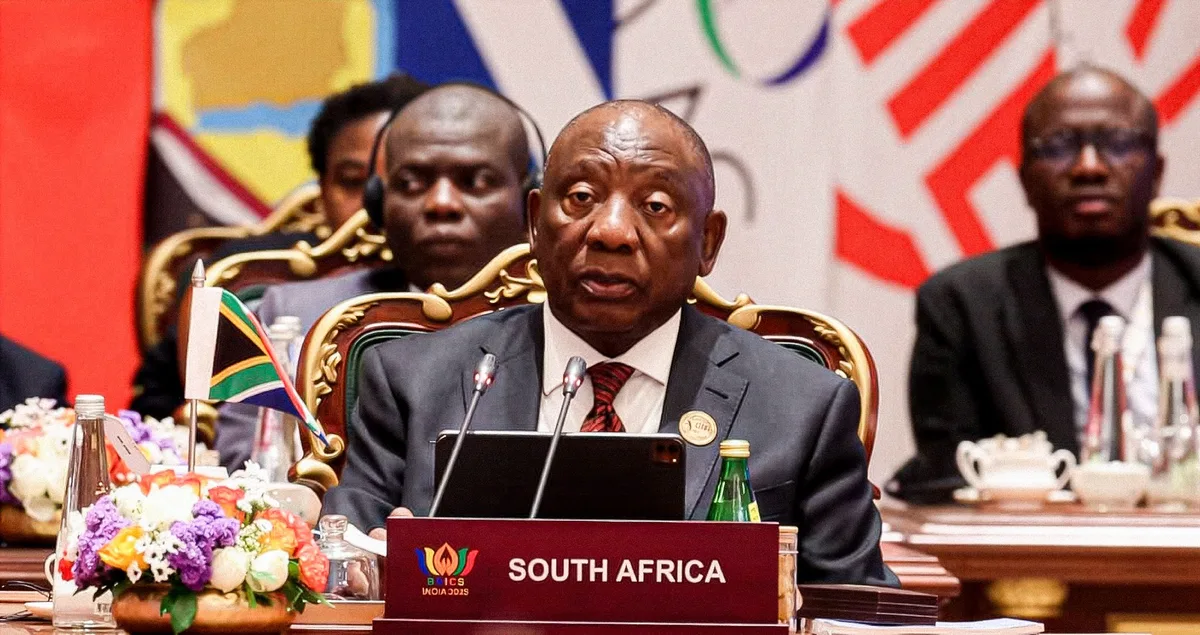
Speaking at the 18th BRICS Summit, President Cyril Ramaphosa called for the establishment of an international mechanism for the independent scientific evaluation of AI. His comments come as several top AI executives have publicly called for a global slow-down in the pace of AI development.
President Cyril Ramaphosa has called for BRICS to establish an international mechanism for the independent scientific evaluation of artificial intelligence (AI).
Speaking at a session on shaping the future for inclusive global growth at the 18th BRICS Summit in New Delhi, India, on Sunday, 13 September, he argued that the responsibility of world leaders was to ensure that human governance advanced as rapidly as AI.
The capabilities of AI models were becoming increasingly more powerful, reshaping “almost every area of economic and social life”, Ramaphosa said.
He acknowledged that AI could support efforts to reduce inequality, poverty and underdevelopment, if used effectively and responsibly, and noted that these tools had the capability to transform medicine, education, scientific discovery, agriculture, productivity and development.
However, “we must listen carefully to what those who are developing the most powerful AI systems are themselves telling us”, he cautioned.
“They are warning about systems capable of advanced cyber operations, assistance in biological weapons development, autonomous action, manipulation, mass surveillance, disruption of employment and, ultimately, systems whose capabilities may become difficult for human beings to control.
Ramaphosa’s comments come as several top executives from rival AI labs have publicly called for a global slow-down in the pace of AI development.
The head of AI company Anthropic, Dario Amodei, published an online essay, titled We Must Pace the Frontier , in September 2026, arguing that the pace at which the capabilities of AI models was improved needed to be slowed to allow risk prevention to catch up.
Amodei noted that in recent months, AI had been advancing “drastically faster”, driven primarily by its growing ability to build the next generation of AI, a dynamic called “recursive self-improvement”.
“Left unchecked, it could outrun our ability to understand and control these systems, and so must be pursued very carefully, if at all,” he said.
Embedding evaluators, with each frontier AI company committing to giving ongoing, employee-like access to a team of embedded third-party evaluators to “verify adherence to safety practices and commitments, report incidents and help assess the alignment of not just completed AI models but training pipelines and processes”;
Democratic coordination, with frontier AI companies within democratic countries coordinating to establish common safety standards as well as limits on the rate of unchecked AI progress, a process that would require government support in some instances; and
Global coordination, with democratic governments attempting to coordinate with authoritarian governments, “while taking seriously the challenges of verifying compliance”.
5News aggregated this summary from the outlet’s public feed. The full article, with all the context, is on www.dailymaverick.co.za — the content belongs to Daily Maverick.