Early mammals weren’t all loners, as scientists thought – some already lived in pairs alongside the dinosaurs
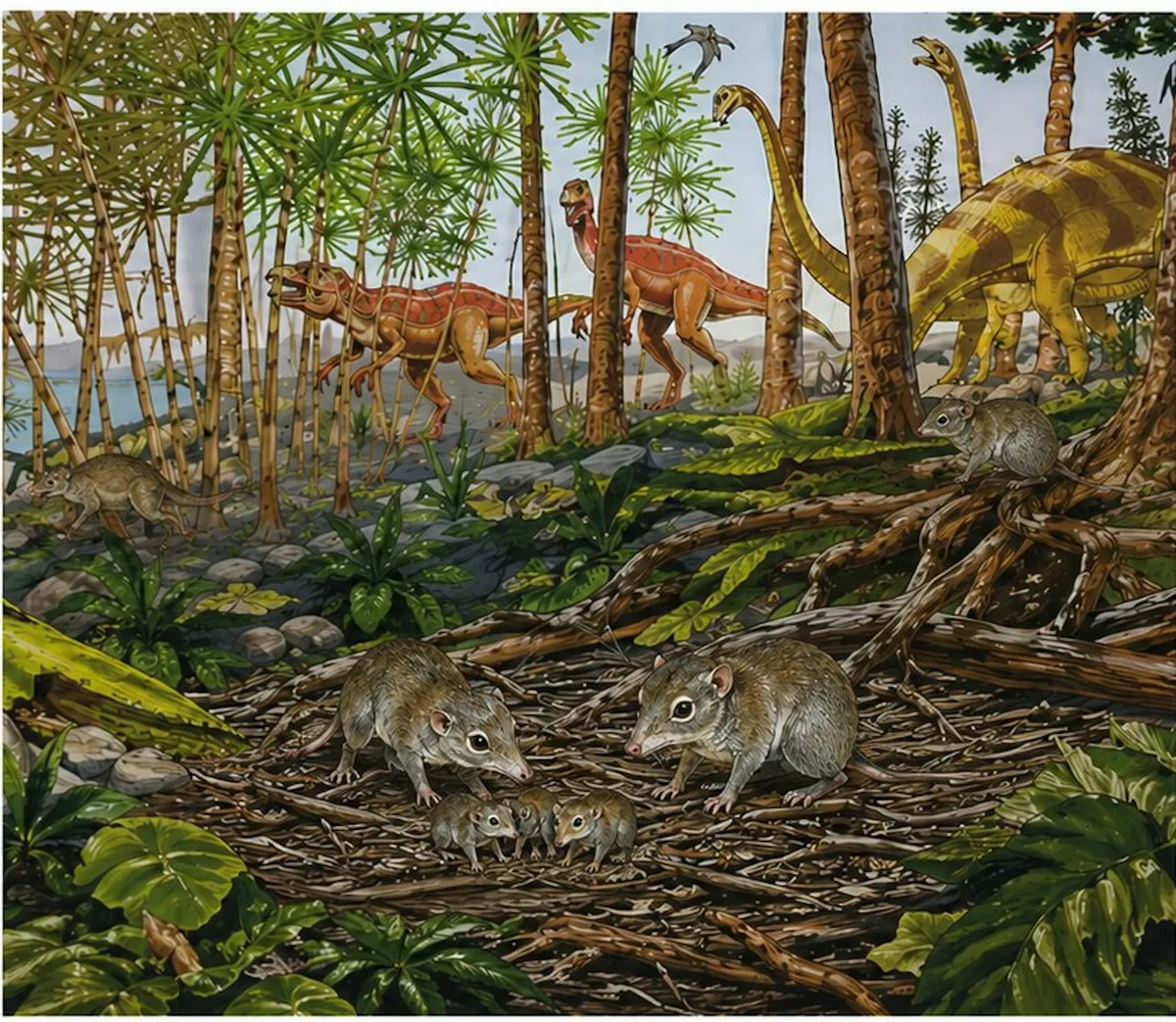
Illustration of early mammals and dinosaurs.
Generated by ChatGPT.
About 200 million years ago, furry little egg-laying creatures evolved the ability to feed their offspring with a secretion from some special glands: milk.
Their evolutionary journey continued and by about 160 million years ago, the first mammals with a real placenta had come into being.
Instead of laying eggs, they gave birth to live young that had been connected via a placenta directly to their mother during pregnancy, allowing the exchange of oxygen, nutrients and waste products.
These early mammals looked like shrews do today.
They were small and had a long body, eyes typical for nocturnal mammals and little spiky teeth for eating insects.
But they were not shrews.
They were the ancestors of all the placental mammals that exist now, including shrews, bats, elephants and humans.
Juramaia, a very early placental mammal that lived about 160 million years ago.
Wikimedia While we know quite a lot about what our ancestors looked like and what they ate, so far we didn’t know anything about their social behaviour.
Because behaviours don’t fossilise.
Scientists used to think that the first placentals behaved like shrews because they looked like shrews.
And as the common belief was that all shrews are solitary, scientists thought the first placental ancestors were too.
5News aggregated this summary from the outlet’s public feed. The full article, with all the context, is on theconversation.com — the content belongs to The Conversation Africa.


