Families torn apart as fighting escalates in Yemen
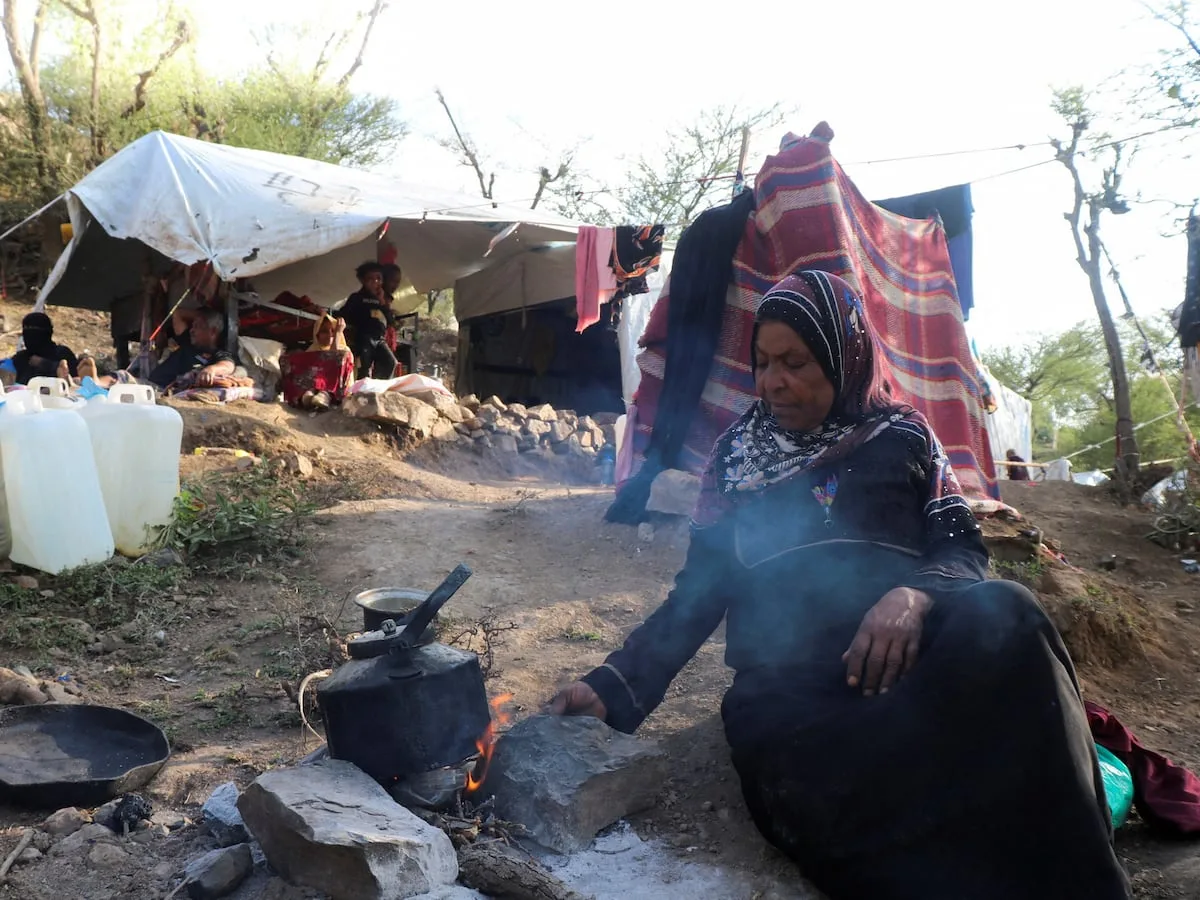
As Yemen ’s Iran-aligned Houthi militants swept through the battered country’s Red Sea coastline, thousands of panicked people fled to makeshift camps, adding to an already vast population of internally displaced people.
Aisha Muhammad, like others who escaped from coastal areas and arrived in the southwest province of Taiz, left behind her two daughters and three sons, who were trapped in their homes as fighting turned a once-vital corridor for trade into a route of displacement.
“They are being blocked and shot at. Right now they cannot reach us and we cannot return to them. This is a trial from God,” said Muhammad, boiling water in an old black teapot placed on rocks over a flame.
More than 82,000 people have been displaced by the fighting since the start of the month, the International Organisation for Migration (IOM) said on Sunday, including over 2,000 who have crossed the Gulf of Aden to Djibouti in the Horn of Africa.
The advance by the Houthis, who already control most of the north and Yemen’s most populous areas, is strengthening Tehran’s hand in its conflict with the US.
Hardship is not new in Yemen, where a long civil war between forces of the internationally recognised, Saudi-backed administration and the Houthis created one of the world’s biggest humanitarian crises.
Yemen has been mired in conflict since the Houthis seized the capital Sanaa in 2014, prompting a Saudi-led military intervention the following year. A UN-brokered truce in 2022 largely halted major fighting, despite expiring six months later, but efforts to turn it into a lasting political settlement have stalled as regional tensions have intensified.
The Houthis — mountain fighters in sandals who have transformed into a force of tens of thousands with missiles and drones — have opened a second theatre of war with their lightning western offensive.
Their advance has put them in a strong position to tighten their grip on the strategic Bab el-Mandeb Strait — a vital chokepoint for global oil and commodities shipping — more than six months after the US and Israel attacked Iran.
“Behind every number is a family who’s lost everything,” said IOM director-general Amy Pope. “Many have been displaced multiple times. People are crossing the sea with nothing because they have no other choice left. Yemen is a country torn by poverty and conflict, and it cannot carry this crisis alone.”
Video shared by IOM showed Yemenis who arrived by boat on Djibouti’s northern coast receiving food and water at a nearby refugee settlement.
Djibouti’s finance minister, Ilyas Dawaleh, said on Sunday the situation was “becoming increasingly difficult for our country, despite our unwavering commitment to humanitarian resources”.
Back in Taiz, many — including Abdullah Qaiyd, an elderly man walking with a stick — are once again longing for stability.
“Now look at us. We are tormented and shaken to our core. We long for a basic livelihood and we long for safety,” he said.
5News aggregated this summary from the outlet’s public feed. The full article, with all the context, is on www.sowetanlive.co.za — the content belongs to Sowetan.