Thousands missing, aid needs mount one month after Nepal's deadly floods
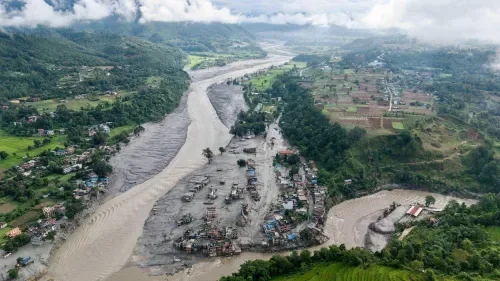
Nepal is reeling from the devastating August 26, tsunami-like flood that cut a swathe of destruction through the Himalayan nation. The disaster was triggered by a high-altitude glacial mountain collapse on the China-Nepal border, that scientists have linked to climate change.
The tsunami-like flood that cut a swathe of destruction through Nepal on August 26 has left the Himalayan nation grappling with heavy losses and mounting reconstruction needs.
One month on, AFP looks at the scale of the disaster triggered by a high-altitude glacial mountain collapse on the China-Nepal border, which scientists have linked to climate change.
On August 26 at 8:37 am (0252 GMT), a mass of ice and rock broke away from the north face of Nepal's Langtang Lirung mountain, sending a huge mass of debris racing down the valley.
The collapse began at an altitude of about 5,200 metres (17,060 feet) with a section more than a kilometre (0.6 miles) wide and extending roughly 700 metres vertically.
That mass of rock and ice plunged about 800 metres onto a debris-covered glacier, before surging downhill, briefly damming the Lhende River. Water and debris then burst downstream.
The debris travelled about 20 kilometres, dropping 1,700 metres at Rasuwagadhi in only seven minutes, said Sudan Bikash Maharjan, a geologist with the Kathmandu-based International Centre for Integrated Mountain Development.
"The elevation difference is high, within a very short length," Maharjan told AFP. "So it just rushed down like a bullet train."
Nepal's disaster authority says 1,451 bodies have been recovered from the rubble and mud, while more than 5,700 people are missing.
Among the missing are hundreds of workers from hydropower projects swept away by the disaster, along with hundreds more foreigners including tourists and pilgrims caught in the floodwaters.
Identifying victims through DNA has proved a major challenge for Nepali authorities.
With morgues overwhelmed, many bodies have been buried in mass graves after their DNA was recorded.
On the Chinese side, where apocalyptic images showed a border post obliterated, state media have reported 43 deaths and 519 people missing.
Hundreds of rescuers, many deployed by helicopter, have spent weeks digging through mud and debris in search of survivors.
5News aggregated this summary from the outlet’s public feed. The full article, with all the context, is on iol.co.za — the content belongs to IOL.