Cultural experiences enrich China's summer travel season
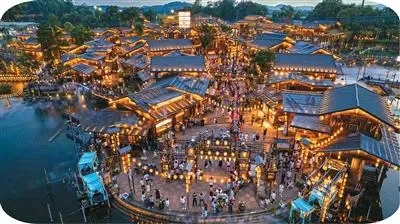
Visitors throng Jiangxiali - Wuhan Old Wharf Cultural and Food Street in Wuhan, central China's Hubei Province, at night.
Museums, sports events, stage performances and literary landmarks are adding cultural variety to China's summer tourist season, giving it a cultural boost this year as travelers move from casual sightseeing toward deeper cultural immersion.
Cultural venues across the country have extended opening hours this summer, rolling out theme exhibitions, immersive study tours and intangible cultural heritage (ICH) experiences to draw families.
At the National Natural History Museum of China in Beijing, a special "Museum Night" program lets visitors explore its dinosaur exhibition hall after dark.
In Weinan, northwest China's Shaanxi Province, the Weinan Museum has moved beyond its exhibition halls to host outdoor concerts blending classic songs with local history.
In Shunde, south China's Guangdong Province, a script-based tour built around an exhibition on xiangyunsha, a prized traditional silk fabric, invites visitors to role-play as dyeing workshop owners or fashion designers while solving story-driven puzzles.
Similar programs have appeared in Tongjiang, northeast China's Heilongjiang Province, where a local museum pairs fish-skin painting, a craft of the Hezhe ethnic group, with local history.
In Anshun, southwest China's Guizhou Province, visitors drawn by the Huangguoshu Waterfall are also trying their hand at painting Dixi opera masks and exploring other ICH handicrafts.
In southwest China's Yunnan Province, tie-dye workshops in Dali and folk experiences in Lijiang's Yuhu village are helping to integrate agriculture, culture and tourism.
"Intangible cultural heritage is moving beyond static displays and embedding itself in everyday life," said Cai Hong, director of the Tourism Research Center of Capital University of Economics and Business.
A "Harbin Ice Show" performance takes place in Harbin, northeast China's Heilongjiang Province.
This summer, sports events and stage performances are also driving cultural and tourism spending. In Weifang, east China's Shandong Province, a grassroots football tournament lets ticketholders claim free entry to several scenic spots and hotel discounts, alongside a fan marketplace selling local foods and ICH products.
Similar scenarios of the "ticket stub economy" can be seen at the Yuelu Mountain Youth Theatre Festival in Changsha, central China's Hunan Province, and the months-long Harbin Summer Music Season in Harbin, Heilongjiang Province.
Another trend seen this summer is travellers following books rather than traditional itineraries. Readers are visiting literary landmarks including Beijing's Ditan (Temple of Earth) Park, the setting for writer Shi Tiesheng's famous essay "The Temple of Earth and I", and Shanghai's Wukang Road, which is associated with Eileen Chang's writings.
5News aggregated this summary from the outlet’s public feed. The full article, with all the context, is on iol.co.za — the content belongs to IOL.