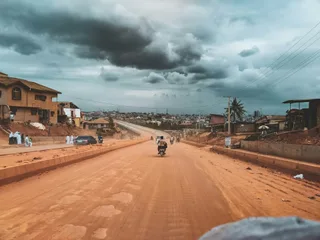
Along Nigeria’s ‘spiritual highway’, prayer camps create a new urban future

The highway between Lagos and Ibadan was built in 1978 at the height of Nigeria’s oil boom.
Lagos is the country’s largest city, with an estimated population of over 20 million , and Ibadan the third-largest and home to a globally renowned university .
But the boom years are over and rising traffic and decades of neglect have turned the Lagos-Ibadan Expressway into one of Nigeria’s deadliest motorways , earning it the nickname “highway of death”.
Yet even as the 127km stretch of road has faltered as a transport corridor linking north and south, it has flourished as a stage for public religion.
Today, lined with sprawling prayer camps, it’s also known as the “ spiritual highway ”.
Religious billboards have replaced road signs and religious camps have been established along the route.
For years my research as an anthropologist has explored how multi-faith settings challenge conventional ideas of religion.
I have studied the more than 30 religious organisations that have established vast prayer camps along the course of the highway since the 1980s.
Attracting tens of thousands of worshippers seeking health and wealth, they have transformed the expressway into an urban spiritual centre.
These sites consist of vast, factory-like prayer halls.
They offer a wide range of facilities, including shopping malls, restaurants, banks, hotels, health clinics, schools, and even universities .
As a result, many have evolved into “ prayer cities ” that combine urban and religious worlds within a single space.
While drawing vast crowds during religious programmes, a growing number of camps provide permanent residence for members seeking to escape what they perceive as the moral corruption of urban life.
By supplying services often lacking in Lagos and Ibadan, like reliable electricity, a clean and secure environment, and spiritual redemption, these camps have developed into “ religiocities ”.
5News aggregated this summary from the outlet’s public feed. The full article, with all the context, is on theconversation.com — the content belongs to The Conversation Africa.