India T20 ceremony sparks debate over full ‘Vande Mataram’ rendition
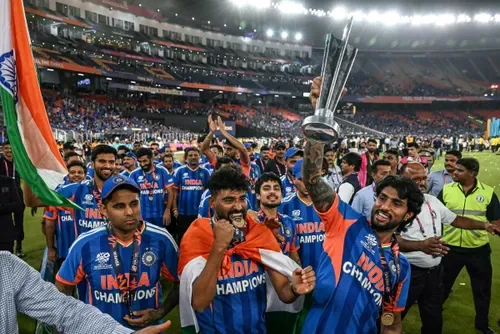
The full six stanza version of ‘Vande Mataram’ was played before the national anthem at an India international cricket match for the first time, bringing a historic freedom song and a long running debate over patriotism, religion and national identity onto the cricket field.
India’s national song, ‘Vande Mataram’, was performed in full before the national anthem at an international cricket match in New Delhi, reviving debate over patriotism, religion and Hindutva.
Before Sunday's T20 game between India and Afghanistan in New Delhi, players and spectators stood as "Vande Mataram" was sung before an international cricket match in India for the first time - ahead of the national anthem.
The six-stanza rendition lasted more than three minutes, putting the 19th-century song at the centre of a modern debate over nationalism and religion in constitutionally secular India, home to 1.4 billion people.
Some Indian players sang the opening lines, but most stood silent before singing the national anthem that followed.
"Vande Mataram", meaning "Mother, I Bow to Thee", was a poem written by Bengali author Bankim Chandra Chattopadhyay and first published in 1875.
The verse is in Sanskrit - the root language of Hindi - making it hard for many to understand or sing.
"The development of the hymn from a poetic composition to a national song exemplifies India's collective awakening against colonial dominance," the government said in a 2025 statement.
"Vande Mataram" was officially adopted as India's National Song in 1950. But it is not India's national anthem.
That is "Jana Gana Mana", or "the Minds of all the People", which was also formally adopted as the anthem in 1950.
Britain's colonial rule ended in the bloody 1947 partition that created Hindu-majority India and Muslim-majority Pakistan.
While the opening two stanzas praise the motherland, subsequent verses invoke Hindu deities including Durga, Lakshmi and Saraswati.
In 1937, the Congress party endorsed only the first two stanzas for public use, seeking to accommodate India's religious diversity, including its large Muslim minority.
Many Muslims object to the song's portrayal of the nation as a goddess, arguing that such veneration conflicts with Islamic teachings.
5News aggregated this summary from the outlet’s public feed. The full article, with all the context, is on iol.co.za — the content belongs to IOL.