Friday 9 October 2026 SourcesAbout🌓
🇦🇺 AU ▾
BREAKING
› Christa Pike walking after botched execution› Ex-prince Andrew search warrants quashed but UK police probe continues› Tennis legend Novak Djokovic to reach out to stricken Jannik Sinner after Italian star’s year ends› Scientists discover 180,000 giant tortoises on one Seychelles island› Pedestrian, police car struck after Sydney CBD carjacking› Live: Minister moves to smooth over government response to ATO payment change› ASX set to edge up, Wall Street slides as tech stocks fall, oil prices rise› Thousands march in Madrid after death of evicted pensioner Maricarmen› Messy nails are in. Miu Miu just proved they are abandoning perfect manicures for polish on the cuticles› Canadian poet Anne Carson wins 2026 Nobel Prize in Literature› Christa Pike walking after botched execution› Ex-prince Andrew search warrants quashed but UK police probe continues› Tennis legend Novak Djokovic to reach out to stricken Jannik Sinner after Italian star’s year ends› Scientists discover 180,000 giant tortoises on one Seychelles island› Pedestrian, police car struck after Sydney CBD carjacking› Live: Minister moves to smooth over government response to ATO payment change› ASX set to edge up, Wall Street slides as tech stocks fall, oil prices rise› Thousands march in Madrid after death of evicted pensioner Maricarmen› Messy nails are in. Miu Miu just proved they are abandoning perfect manicures for polish on the cuticles› Canadian poet Anne Carson wins 2026 Nobel Prize in Literature
Science

Nobel prize in chemistry awarded for work on mirror-image molecules
The Guardian Australia - Science ·
Nobel prize in chemistry awarded for work on mirror-image molecules

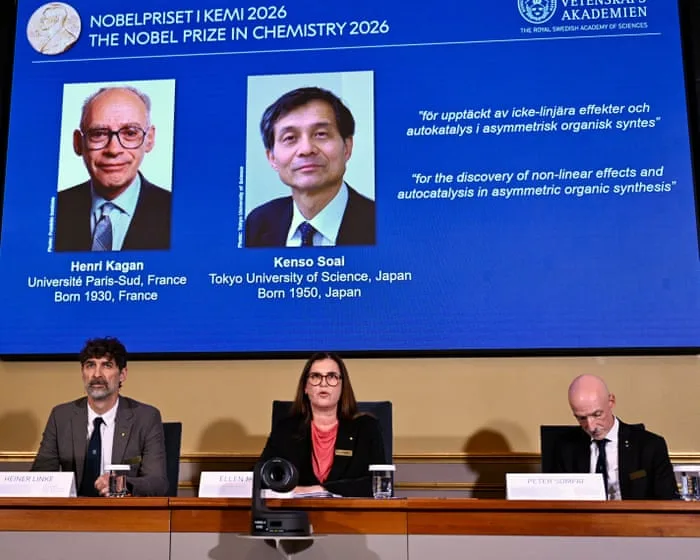
Henri B Kagan and Kensō Soai awarded prize for discovery that has aided understanding of how medicines work in the body The Nobel prize in chemistry 2026 has been awarded to two scientists for discoveries that showed how chemical reactions can produce an overwhelming excess of one of two mirror image forms of a molecule.

Henri B Kagan at Paris-Sud University in France and Kensō Soai at Tokyo University of Science in Japan have been awarded the prize “for the discovery of nonlinear effects and autocatalysis in asymmetric organic synthesis”.

Continue reading...

Read the full article on The Guardian Australia - Science ›

5News aggregated this summary from the outlet’s public feed. The full article, with all the context, is on www.theguardian.com — the content belongs to The Guardian Australia - Science.
More from The Guardian Australia - Science

See all ›

More in Science

See all ›