Are earthquakes becoming more common? Here’s what the numbers say
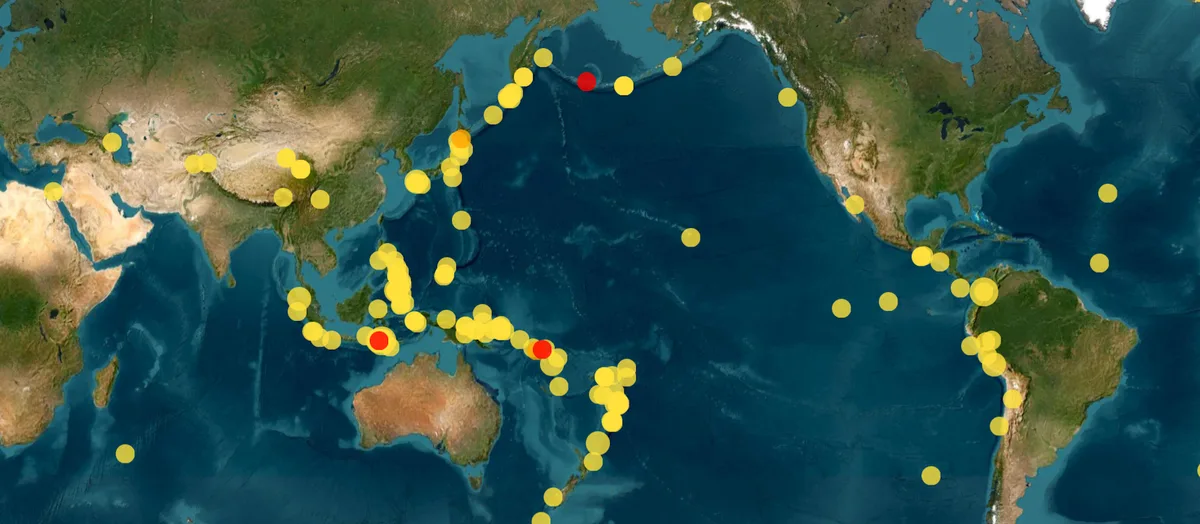
Magnitude 5+ earthquakes in the past 30 days.
Geoscience Australia, © Commonwealth of Australia , CC BY Whenever there’s a series of destructive or notable earthquakes, scientists get asked the same question: are earthquakes becoming more frequent? Over the past three months, multiple large earthquakes have occurred near population centres around the world, resulting in devastating impacts to people and infrastructure: Philippines (magnitude 7.8) Indonesia (M7.7) Venezuela (M7.5 and M7.2) Colombia (M7.4) Japan (M6.8).
In addition, there have been moderate-sized earthquakes on Hawai’i Island (M6.0) and Granada, Spain (M5.2) that have caused minor to moderate damage.
Is this unusual? To answer that question, we need to look at the data.
Occurrence rates Earth is a dynamic planet and there are always earthquakes occurring somewhere.
Most are too small or too far away to feel and go unnoticed by most people.
However, there is a large earthquake somewhere (larger than M6.5) about every eight days on average.
This means there are usually around 46 earthquakes of magnitude 6.5 or greater each year.
As of August 21, there have been 26 earthquakes of M6.5 or more in 2026, shown as yellow dots in the global map above.
Statistically, the number of M6.5 or larger earthquakes so far this year is on track to be slightly fewer than average, as well as slightly below the annual frequency over the past 40 years, which is shown by the dashed line in this chart.
Tectonic setting Earthquakes are primarily clustered along tectonic plate boundaries and are caused by the motion of these plates.
These regions have higher seismic hazard , such as near the well-known San Andreas Fault in California, the Alpine Fault in New Zealand, the southern Caribbean and also around the edge of the Pacific plate, the so-called Ring of Fire, where volcanoes are another geohazard .
To improve our understanding of earthquakes and their hazards, we monitor and record earthquakes globally, but also strategically install sensitive instruments in regions that are seismically active.
Over the past few decades the data from these instruments have dramatically increased, while new technologies and methodologies have been developed to learn more about earthquakes.
5News aggregated this summary from the outlet’s public feed. The full article, with all the context, is on theconversation.com — the content belongs to The Conversation Australia.