Want to muck around with a real quantum computer? Now you can
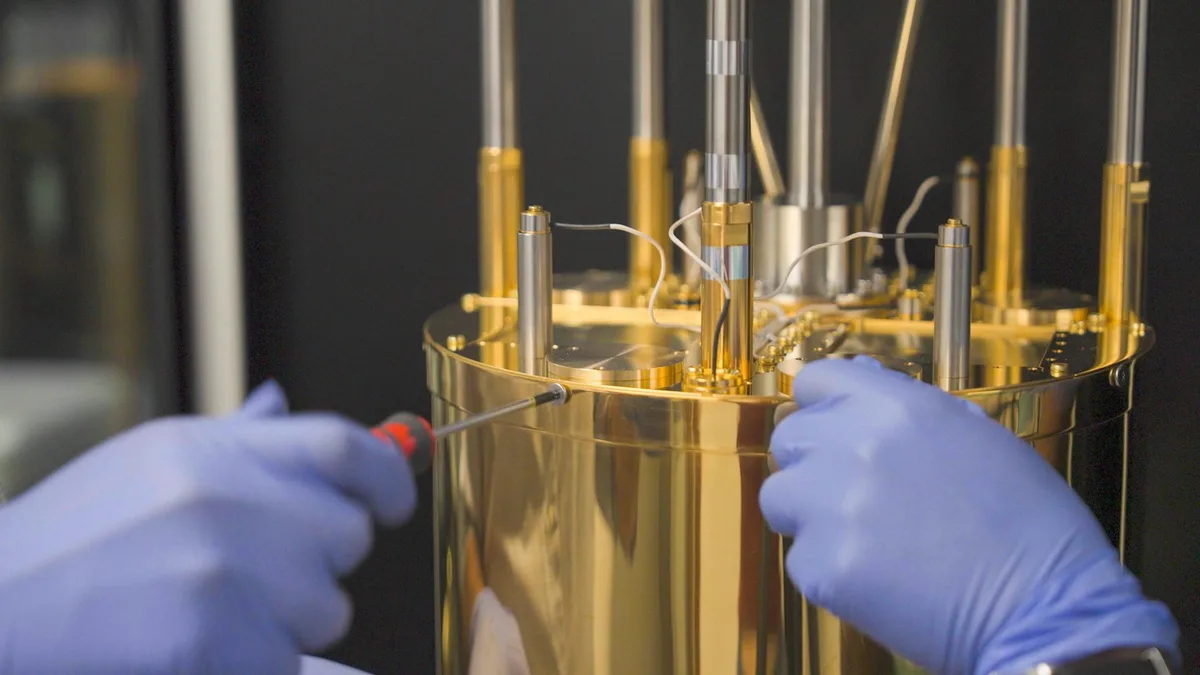
A close up of the golden frame which holds the quantum processors at the new quantum testbed.
The University of Queensland Quantum computers are expected to transform many facets of science and industry over the next decade or so – but it’s very hard for most potential users to get their hands on one to find out what they can actually do with it.
A new open-access facility opened in Queensland this week aims to change that.
The A$10.5 million National Quantum Computing Testbed is located at the University of Queensland and is a collaborative effort led by research teams from the university and CSIRO.
It will allow researchers from academia and industry to test new ideas on a real quantum processor in an affordable and fully open access environment.
As such, it removes many of the barriers to innovation in this rapidly developing field.
From bits to qubits Everyday classical computing, like the kind that runs our laptops or mobile phones, stores and processes data in the forms of bits.
These are are binary numbers – for example, combinations of 0s and 1s.
Each bit can be either 0 or 1 at any given time.
Quantum computing, however, stores and processes information as quantum bits – otherwise known as qubits.
These exploit special properties of quantum physics to create what are known as “ superposition ” states.
At any instant each qubit can be 0 or 1, like a traditional bit – or it can be any combination of both 0 and 1 simultaneously, such as 30% 0 and 70% 1.
This will allow quantum computers to process certain kinds of very large datasets extremely fast .
In turn, they could generate new discoveries which address challenging problems across various fields, from medicine and renewable energy to cybersecurity and urban design.
5News aggregated this summary from the outlet’s public feed. The full article, with all the context, is on theconversation.com — the content belongs to The Conversation Australia.