The far right is becoming normalised in Germany – and winning. Australia should take heed | Charlotte Feakins
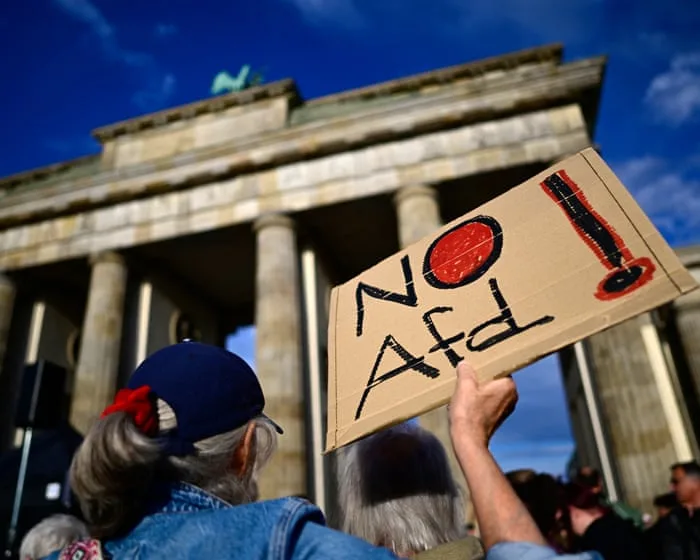
One Nation and the AfD may not look the same, but they are singing from the same song sheet - and both have had recent electoral success
The recent win for the Alternative für Deutschland (AfD) in Germany is shocking, except it’s not shocking. The writing has been on the wall for quite some time.
Last Sunday, the far-right, pro-Russian and anti-immigration AfD won almost 44% of the vote in the election in Saxony-Anhalt, a largely rural state in the former East Germany, more than doubling its previous result and finishing far ahead of the Christian Democrats.
It sits within a troubling global trend. In 2025, nearly one in four countries worldwide experienced democratic backsliding , with Europe and North America home to six of the 10 countries newly identified as autocratising, including Italy, the UK and the US.
Despite the cultural and historical differences, Australia is not immune. We cannot afford to be complacent.
This time last year, I travelled to Mecklenburg-Vorpommern, a predominantly rural region in Germany’s north-east, to examine the culture of the far right and its counter-responses as part of my research. Like Saxony-Anhalt, it’s an area where the AfD has significant support. My colleagues and I spent days walking the streets of towns and cities, including Rostock and Greifswald, as well as attending an anti-fascist music festival. We wanted to understand how extremism was encountered and expressed in everyday life. But what we found, or more precisely did not find, surprised us.
For a politics so extreme and increasingly popular, visual expressions of the far right were remarkably scarce. We encountered graffitied walls and hundreds of activist stickers on street signs, lamp-posts and electricity boxes. Of these, only one or two were associated with the far right. The counter-movement dominated the streetscape. Its stickers and graffiti were vibrant, loud and sharp, with a clear intent and recurring “anti-fascist” message. Yet a subtler pattern was emerging. The far right was made visible not through its own stickers or graffiti, but in the intolerance directed towards the counter-movement: freshly placed anti-fascist and pro-refugee stickers were being actively defaced.
Looking back now, that landscape feels strangely prescient. As far-right ideas move beyond the fringe and enter mainstream political discourse, they become harder to detect, let alone recognise as extreme – an insidious process that gradually reshapes what is considered “normal”.
In Australia, we tend to imagine the far right as young white men dressed in black and wearing balaclavas, marching through the streets, performing Nazi salutes or standing in front of historic buildings holding banners. These deliberate acts of spectacle are designed to attract attention, provoke and intimidate. They are easy to identify and condemn, appearing separate from the political mainstream.
But far-right politics does not only appear wearing a balaclava. Increasingly, it does not look extreme at all. Across Europe, far-right politicians are neat, polished and smooth-talking. They are unnervingly normal .
5News aggregated this summary from the outlet’s public feed. The full article, with all the context, is on www.theguardian.com — the content belongs to The Guardian Australia - Australian Politics.