You can't buy anything on these food delivery and shopping sites. Here's why that's the point
The cart is full. The items have been picked. The checkout button is waiting. You click “place order” — and then nothing happens.
There’s no delivery driver on the way. No charge to your credit card. No package waiting at your door. And that’s the point.
A new wave of mock shopping websites is giving people the thrill of shopping without the bill, as younger, budget-conscious consumers look to curb compulsive spending.
The trend first took off in South Korea , where some turned to simulated shopping sites to recreate the satisfaction of making a purchase without the financial hit, amid high living costs and a culture of consumerism.
Now, the idea is spreading globally. Whether it’s "buying" everyday essentials, adding clothes to a virtual cart or pretending to order a meal, sites such as DopamineCart, FakeEats, DopaHaul and FakeHaul are recreating the familiar rituals of online shopping without anything ever being delivered.
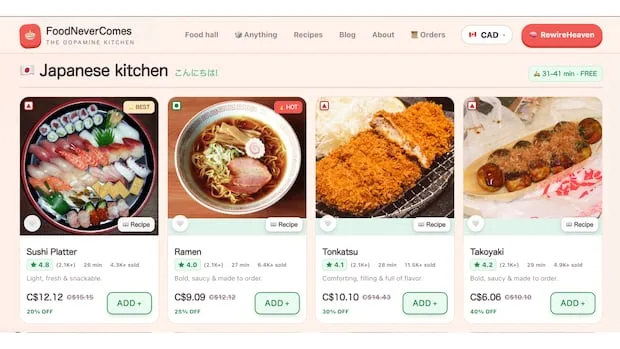
One example is FoodNeverComes, a fake food-delivery site launched in late June that has attracted around 92,000 active users over the last 90 days, according to the site's co-creator Anshul Sharma. They can fill their carts with meals and drinks, go through a mock checkout and follow their order being processed on a virtual map as it’s being “delivered.”
Sharma and his co-creator Purvansh Parmar, both based in Udaipur, India, say the self-funded, ad-free site has recorded about 1.1 million interactions.
The U.S. is its largest user base, says Sharma, followed by China, the U.K. and Vietnam, with Canada coming in third or fourth.
For Parmar, the project hits close to home. He says he struggled with excessive food-delivery orders himself, spending up to 20,000 rupees ($200.70) a week before realizing he had fallen into a cycle of compulsive spending for the convenience.
"I guess it was so easy, you just 'click-click-click,' get the food," he said. "You think you like the food, but in the end, it isn't actually the reason.”
To help users break the habit of online shopping, the duo also shares recipes to encourage people to cook at home instead of ordering in.
Rhia Catapano, an assistant professor at the University of Toronto who studies consumer behaviour and psychology, says online shopping simulators can activate “the same parts of our brain that doing the actual activity would.”
“Like playing a video game or dreaming about a vacation that you're never actually going to take, we can imagine a thing,” she said. “In some way, it gives us some of the same psychological benefits.”
But whether the sites are truly helpful depends on why someone is using them, says Catapano.
5News aggregated this summary from the outlet’s public feed. The full article, with all the context, is on www.cbc.ca — the content belongs to CBC News.