People are trading mummified human remains online. Some scientists say that may be bad for their health
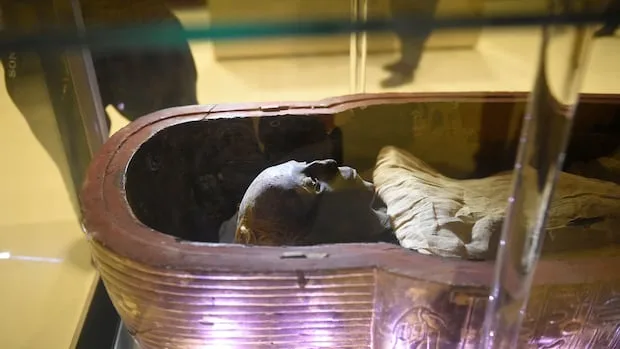
It's not something most people would picture being inside your average delivery package, but scientists say there's a global market online for preserved human remains — a niche hobby they say poses potential health hazards.
In a study published in the International Journal of Cultural Property , lead author Kirsty Squires and her team analyzed 128 web posts from 2015 to 2025 showing off or advertising remains from both humans and animals for sale.
"Mummified heads, hands and feet were very common," said Squires, a bioarchaeology professor at the University of Staffordshire in Stoke-on-Trent, England.
Mummified body parts can harbour dormant microorganisms — such as bacteria, fungi and yeast — that the researchers warn could cause health issues for some people when not properly handled, though some experts say there's not much cause for concern for collectors who know what they're doing.
Squires said a number of the online images showed "visible signs of deterioration of remains, and this is primarily caused by poor storage conditions."
In museums, mummies are kept in safe storage where temperature and humidity are strictly controlled.
"But if remains are kept in, you know, homes or garages or wherever they are holding these bodies or body parts, they're not going to be … experiencing controlled environmental conditions," she said.
Handling those remains could release hidden fungal spores or bacteria, which can survive in mummified human tissue for centuries or more, into the surrounding air, the researchers say.
When Squires handles human remains as part of her research, she wears protective equipment.
Squires says immunocompromised individuals could be at risk if exposed to airborne microorganisms, which she says could affect the lungs as well as irritate skin and eyes.
Some mummified body parts can also have traces of highly toxic chemicals on them, such as arsenic and mercury, that have been found in 19th and early 20th century embalming fluids, according to the study.
The paper does not say how many people, if any, have become sick from handling human remains sold online, but there are cases where coming face to face with historical human remains has proved fatal.
In 1973, 10 out of 12 conservation scientists died after inhaling Aspergillus spores — a common mould — after opening the 15th century tomb of King Casimir the Fourth of Poland.
Some have speculated airborne fungal spores were a factor in the death of British archaeological patron Lord Carnarvon in 1923, who may have been exposed inside the burial chamber of Tutankhamun. His death six weeks after entering the chamber sparked rumours he had been "cursed" for disturbing the Egyptian pharaoh's resting place.
5News aggregated this summary from the outlet’s public feed. The full article, with all the context, is on www.cbc.ca — the content belongs to CBC News.