Wildfires expose accessibility failures: advocates
Janice Lyons was upstairs in her Summerland, B.C., home when there was a flash at her doorbell, which lights up in her Deaf household in place of a chime.
The 74-year-old came downstairs to find her neighbour Larry at the front door. He pointed to the black clouds on the horizon and wiggled his fingers to pantomime a fire. It was bad, he seemed to be saying, but he was not leaving yet.
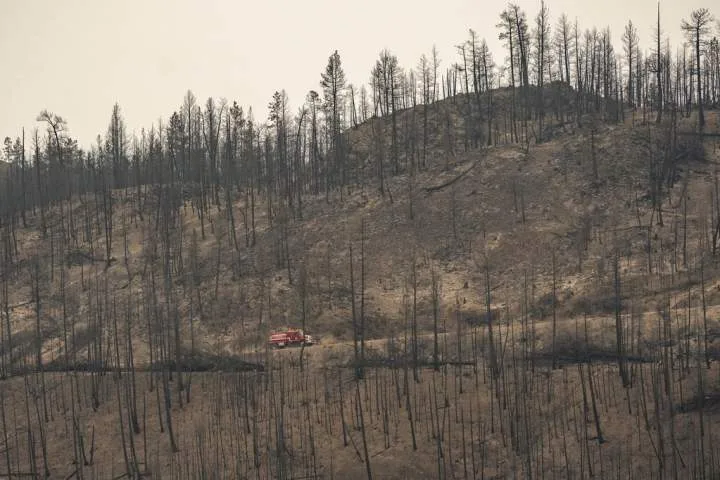
Back inside, Lyons said there was no mention of the fire on her TV or an alert on her phone. She did not realize it yet, but the Bald Range fire was on a blistering path toward her community.
Lyons stayed awake with her husband, who is also Deaf and uses a walker, as she tried to piece together what was happening. When the doorbell flashed again about four hours later, close to midnight, Larry had returned and this time he looked far more panicked. Ash rained down from the sky as he showed her a piece of paper with the name of an evacuation registration centre in nearby Penticton.
“He’s gesturing, no, no bad, bad. Get going,” Lyons said in an interview, through an interpreter.
“If Larry never came to tell me, I have no idea” what would have happened, she said.
Lyons’ experience earlier this month is illustrative of the persistent accessibility gaps in Canada, where surveys indicate roughly one in four people have at least one disability. As wildfires, floods and storms grow more intense and frequent due to climate change, researchers and advocates say evacuation procedures are still largely built around the assumption that everyone can hear the sirens, understand the alert, drive themselves to safety or line up to register at a shelter. Globally, people with disabilities are far more likely to be killed in a disaster than others, studies indicate.
The issue is getting harder to ignore. More than 670,000 people in Canada were evacuated between 1990 and 2020, mostly from floods and wildfires, and some estimates suggest that rate could triple by 2030. Yet, research finds Canadians with disabilities rate evacuation plans as mediocre or poor.
Accessibility is often recognized in principle but rarely built into emergency plans in concrete ways, said Tabassum Zarin, a co-author of a recent study of inclusive B.C. wildfire evacuations.
That research found creating enforceable provincial standards, such as requiring alerts to be delivered in multiple accessible formats and ensuring shelters are accessible, could help address those gaps. It also pointed to a greater role for people with disabilities in designing those policies in the first place.
“If emergency systems are designed from the beginning with accessibility in mind, they’re more safe and effective for everyone,” said Zarin.
The researchers stressed that their findings were not a criticism of local emergency managers, many of whom are responsible for large remote regions with limited staff and resources.
“The goal isn’t perfection because it’s hard to implement that for different communities, different needs. But it’s reducing predictable barriers that we already know exists,” said Zarin.
Predictable barriers showed up several times during Lyons’ evacuation.
5News aggregated this summary from the outlet’s public feed. The full article, with all the context, is on globalnews.ca — the content belongs to Global News.