Anne Carson’s Nobel Prize: Where the ancient world meets postmodern literature
When the Swedish Academy announced Anne Carson as the recipient of the 2026 Nobel Prize in Literature , in Stockholm, I was participating in a panel discussion in the same city at Stockholm University about possible laureates — and the literary traditions they represent.
Before the announcement, I had spoken about two Canadian writers, Margaret Atwood and Carson , whose international recognition reflects different trajectories within contemporary literature.
Carson’s work challenges the very categories through which we usually classify literary achievement.
It moves between poetry, translation, philosophical reflection and the reconfiguration of ancient myths.
The Swedish Academy justified its decision by praising Carson’s “bold and inventive oeuvre” and its “playful dialogue with the classical tradition” that have allowed her to create new forms for contemporary literature.
This formulation captures a fundamental paradox of her writing: Carson’s literary modernity emerges from a persistent return to antiquity , not as a stable cultural inheritance to be preserved, but as an unfinished reservoir of images, voices and fragments capable of unsettling contemporary experience.
Meaning of fragments Fragments of ancient text occupy a privileged position in Carson’s literary universe.
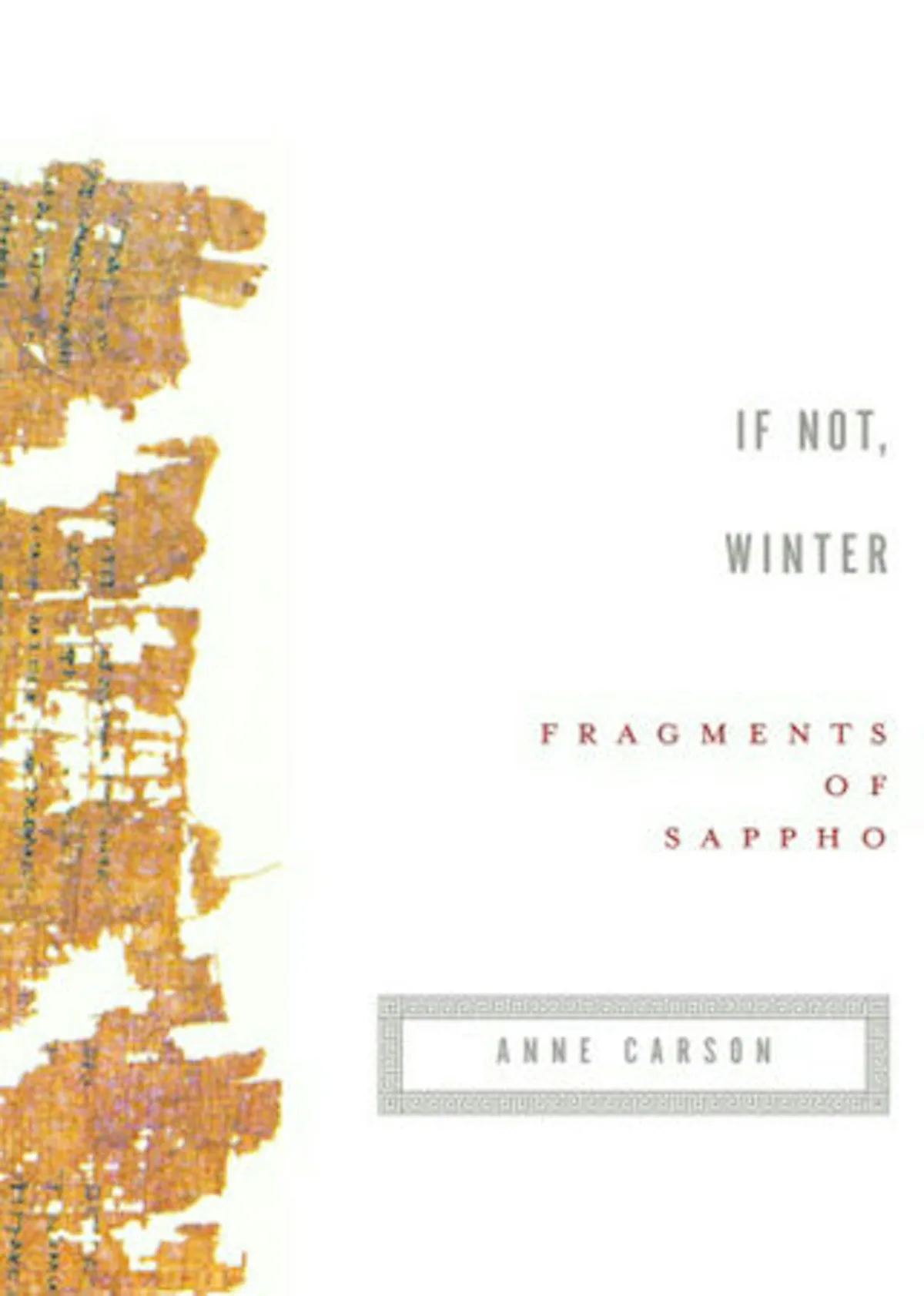
These establish a connection between the material survival of ancient texts and the discontinuous forms associated with modern and postmodern writing. ‘If not, Winter: Fragments of Sappho’ translation by Anne Carson. (Penguin Random House) Carson’s translation of Sappho’s surviving poetry in If Not, Winter (2002) exemplifies this approach.
Carson preserves the gaps and interruptions of the original fragments, rather than attempting to disguise them through speculative reconstruction.
The resulting poems make absence visible, allowing silence and discontinuity to participate in the production of meaning.
This attention to what remains incomplete establishes an unexpected affinity between archaic poetry and modern literary experimentation.
Fragmentation is frequently associated with the crisis of representation in 20th-century literature.
Carson reveals that the ancient textual tradition already contains discontinuities that resist the modern desire for completeness. ‘Eros the Bittersweet’ This relationship between ancient thought and contemporary experimentation is central to Carson’s long essay Eros the Bittersweet (1986) .
This work combines classical scholarship, philosophical inquiry and poetic reflection.
5News aggregated this summary from the outlet’s public feed. The full article, with all the context, is on theconversation.com — the content belongs to The Conversation Canada.