Banding Together to Help DTES Residents Survive Extreme Heat
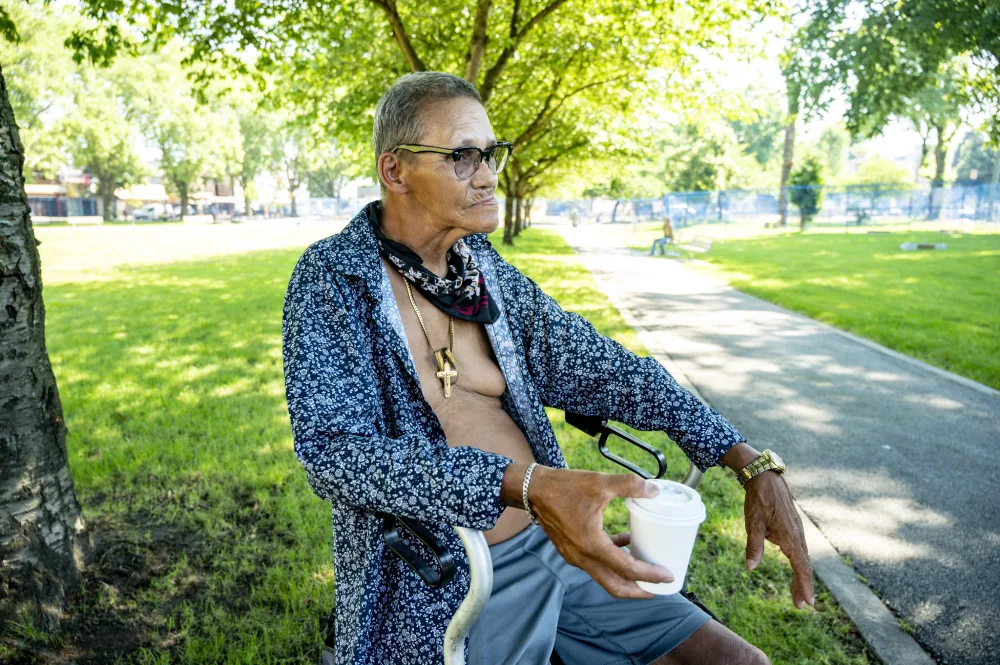
Vancouver organizations are banding together to help protect residents of the city’s poorest neighbourhood, which is at highest risk during extreme heat events.
The Summer Heat Resilience Project is run by the Vancity Community Foundation, Simon Fraser University and frontline non-profit organizations, who work together to support residents of the Downtown Eastside when temperatures soar.
The project aims to shift the way these organizations approach heat events, from emergency response to a state of coordinated preparedness, said Sean Condon, director of social and economic innovation at Vancity Community Foundation.
Condon said social service organizations are struggling to keep the communities they serve safe amidst the overlapping crises of toxic drugs, mental illness and affordability.
Government support is often offered in the form of grants, but endlessly applying for grants eats up organizational time and limits social services’ ability to plan long-term, he said.
“Communities always find a way, but if we don’t prepare ourselves properly for the next crisis and we get another serious emergency these systems are at risk of breaking,” Condon said.
The current social service industry is not set up for climate change, which will bring hotter summers, colder, wetter winters and long smokey seasons, he said.
If social systems collapse during a future extreme weather event, “that will make something that is already incredibly challenging and devastating that much worse,” he added.
The City of Vancouver’s Climate Adaptation Strategy for 2024-2025 calculates that over the next couple decades the average number of days above 25 C will triple, from 20 to 61 per year, and the average number of days above 30 C will increase from one to nine per year.
From 1981 to 2010 Vancouver hit 33 C or higher once every 20 years, but in the 2050s it will hit that same temperature once every other year, the report added.
During the 2021 heat dome, a weather station just south of the airport recorded 32.4 C on June 29, 2021 at 2 p.m., which felt like 39 C with humidity, according to Environment Canada’s historic records . There is no weather station within the City of Vancouver, but, as The Tyee reported during the heat dome, the Downtown Eastside, Marpole and parts of Vancouver’s southeast become the hottest places in the city during a heat wave.
During the heat dome emergency services were overwhelmed and help took hours to arrive , if it ever came.
One hundred and seventeen Vancouverites died, although there was a lower number of deaths in the Downtown Eastside than expected, according to the BC Coroners’ death review panel .
Non-profit organizations have experience responding to emergencies, so building capacity to coordinate planned responses to climate change doesn’t require reinventing the wheel.
5News aggregated this summary from the outlet’s public feed. The full article, with all the context, is on thetyee.ca — the content belongs to The Tyee.