Why is Kaziranga’s Eco-Sensitive Zone in focus? | Explained
Account subscription benefits alongside Premium Stories, Editorials, Opinions and more. Unlock these with Subscription
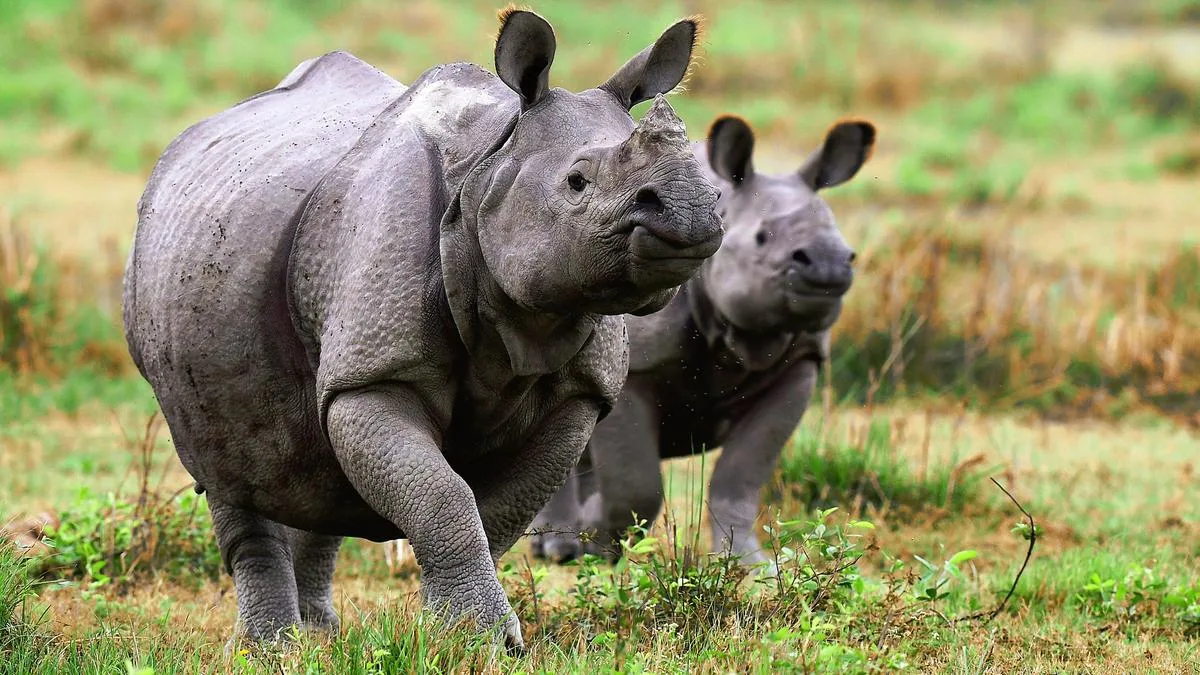
A one-horned rhino with its baby in the Bagori range in Kaziranga National Park. File | Photo Credit: Ritu Raj Konwar
The Assam government recently announced plans to approach the Centre to shrink the Eco-Sensitive Zone (ESZ), a buffer zone around protected areas, to a minimum of 1 km instead of the default 10 km. Chief Minister Himanta Biswa Sarma’s argument that an ESZ of more than 1 km around Kaziranga National Park and Tiger Reserve would affect civic and urban growth in surrounding towns has stoked controversy and raised questions about the government’s seriousness about conserving natural assets.
Also read | Assam CM defends move to reduce Kaziranga Eco-Sensitive Zone to 1 km from the default 10 km
Also known as an Ecologically Fragile Area, an ESZ is a buffer zone or a wide demarcated strip around national parks and wildlife sanctuaries protected by law to stop heavy human damage, lower human-animal conflicts, and improve conservation of natural assets.
The National Board for Wildlife (NBWL) adopted a resolution in 2002 to declare such buffer zones around protected areas under the Environment (Protection) Act of 1986. As part of the National Wildlife Action Plan (2002-2016), the Ministry of Environment, Forest and Climate Change (MoEFCC) instructed the State governments in 2011 to submit site-specific proposals for ESZs, with a general guideline that a buffer zone should be up to 10 km from the periphery of a protected area. The guidelines allowed an ESZ to exceed the 10-km limit to include larger ecologically important sensitive corridors, connectivity patches, and vital landscape linkages.
According to the NBWL, an ESZ is envisaged as a shock absorber to minimise the impact of certain human activities on the fragile ecosystem of the protected areas. In other words, it is considered a transition zone between high-protection areas and low-protection areas, without affecting the daily activities of people living in the vicinity. Such activities have three categories—prohibited, regulated and permitted.
The prohibited activities include commercial mining, sawmills, industries causing air, water, soil and noise pollution, hydroelectric projects, discharge of effluents or solid waste and certain tourism events. Among the regulated activities are felling of trees, establishment of hotels and resorts, commercial use of natural water, erection of electric cables, widening of roads and drastic change of agricultural system with the use of heavy technology, pesticides, etc. The permitted activities include ongoing eco-friendly agricultural or horticultural practices, rainwater harvesting, the use of renewable energy sources and adoption of green technology.
5News aggregated this summary from the outlet’s public feed. The full article, with all the context, is on www.thehindu.com — the content belongs to The Hindu - Sci-Tech.