When corruption resonated in Tamil Nadu political discourse till mid-1970s
Account subscription benefits alongside Premium Stories, Editorials, Opinions and more. Unlock these with Subscription
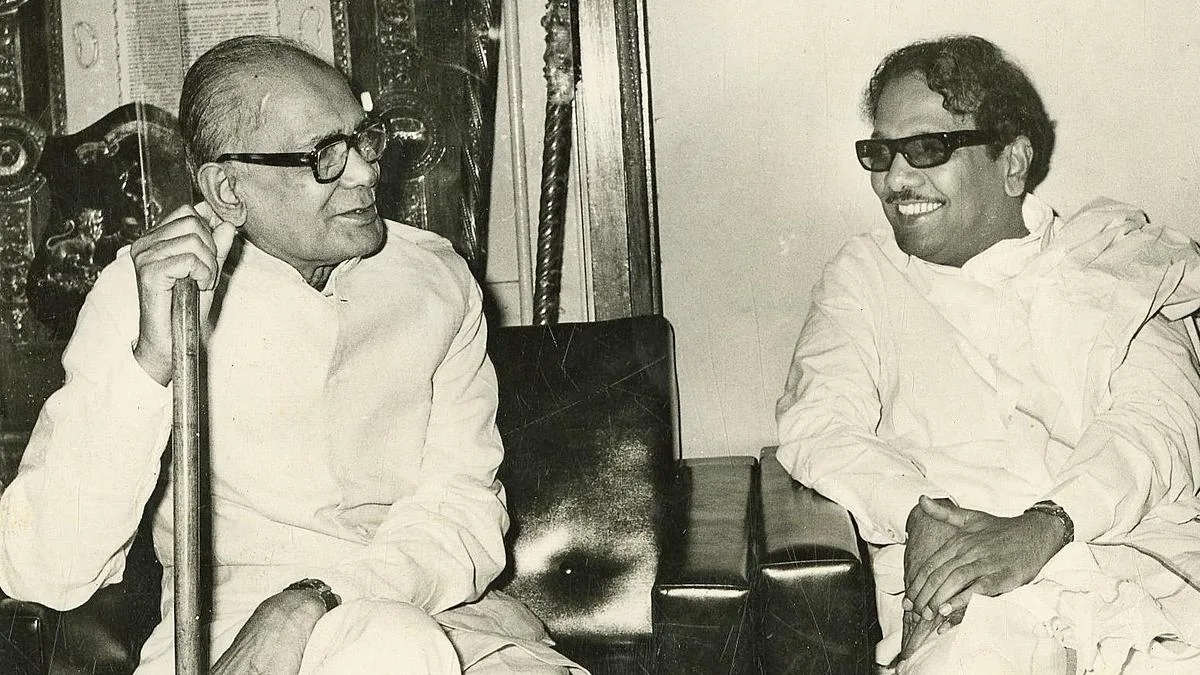
Sarvodaya leader Jayaprakash Narayan (left) calls on then Tamil Nadu Chief Minister M. Karunanidhi (right) at the latter's residence, in Madras on December 26, 1973 | Photo Credit: The Hindu Archives
Tamil Nadu Chief Minister C. Joseph Vijay, in his maiden Independence Day address , gave a call to the people to develop “zero tolerance” for corruption.
Corruption, as an issue at different levels of the administration, had been talked about for years. Parasakthi, a 1952 Tamil film directed by Krishnan-Panju with the 24-year-old ‘Sivaji’ V.C. Ganesan in the lead and written by M. Karunanidhi, who subsequently became Chief Minister and the Dravida Munnetra Kazhagam (DMK )’s longest-serving president, had portrayed the Congress government as “feckless,” in the words of U.N. diplomat-turned-political writer R. Kannan. The film shot Ganesan and Karunanidhi, who was then 28, into fame, paving the way for the growth of the DMK.
In 1957, the Estimates Committee, comprising MLAs, discussed corruption in government hospitals and called for the formation of a sub-committee to go into the issue. In fact, the then Director of Medical Services had responded by saying that the Government General Hospital in Chennai [now named after former Prime Minister Rajiv Gandhi] be covered initially.
Sarvodaya leader Jayaprakash Narayan (extreme right), then Tamil Nadu Chief Minister M. Karunanidhi (centre) and V.R. Nedunchezhian (extreme right) in May 1975 | Photo Credit: The Hindu Archives
Five years later, in July 1962, Finance Minister M. Bhaktavatsalam explained the steps taken by the government to put down corruption. One and a half years later, Bhaktavatsalam, who had, by then, became the Chief Minister, expressed concern over corruption in local bodies and proposed a vigilance body to tackle the problem. In August 1966, his Ministry faced a no-confidence motion in the Assembly with the then Leader of Opposition V.R. Nedunchezhian of the DMK levelling charges of “corruption, favouritism and nepotism.”
However, it was after the DMK captured power in 1967 that the issue of corruption acquired greater proportion. Veteran Tamil writer and once a bitter critic of Karunanidhi and the DMK, Jayakanthan, as quoted by Dr. Kannan in his biography of the DMK founder C.N. Annadurai, commented in 1975 that “in the city [Chennai] corporation, controlled by the DMK, corruption had come to be acknowledged as an ethic in itself.” The DMK regime, headed by Karunanidhi, created a record of sorts when it was dismissed by the Union government in January 1976 for having indulged in “maladministration, corruption, and misuse of power for achieving partisan ends.”
In a proclamation issued on the night of January 31, 1976, the then President, Fakhruddin Ali Ahmed, on the advice of the Union Cabinet led by Prime Minister Indira Gandhi, dissolved the Tamil Nadu Legislative Assembly, apart from imposing the President’s rule in the State. The Centre also constituted a commission of inquiry, headed by Supreme Court judge R.S.
5News aggregated this summary from the outlet’s public feed. The full article, with all the context, is on www.thehindu.com — the content belongs to The Hindu - National.