All eyes on GISAT-1A mission as ISRO aims to mend faulty launch streak
Account subscription benefits alongside Premium Stories, Editorials, Opinions and more. Unlock these with Subscription
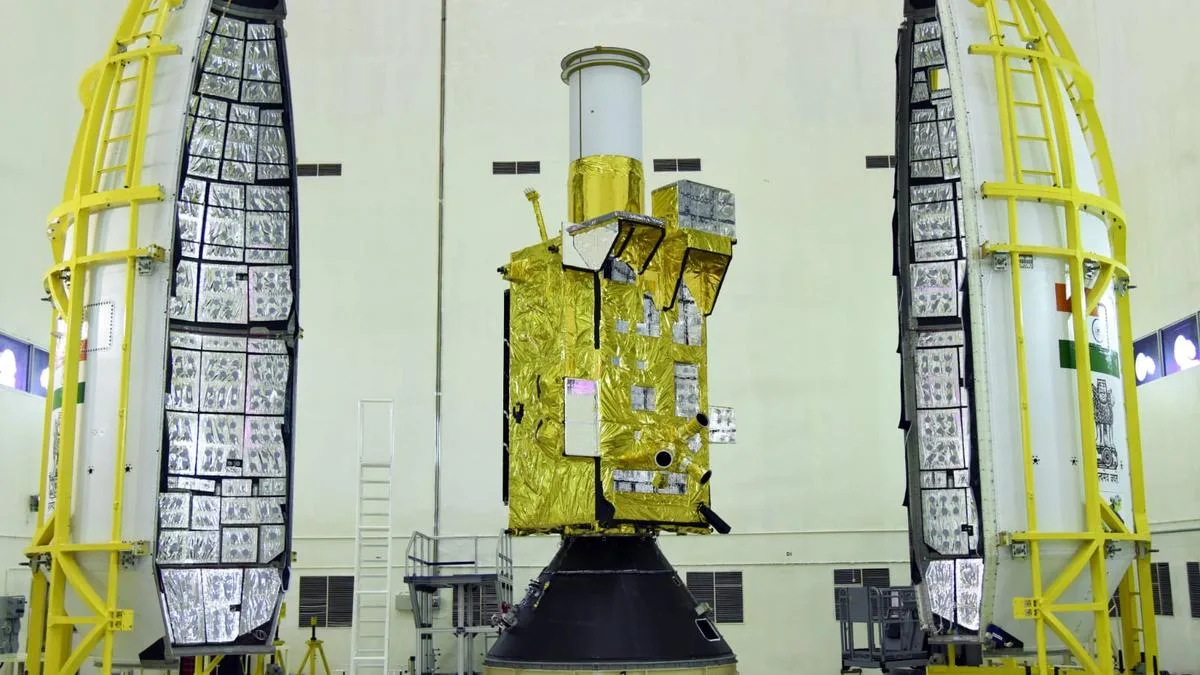
ISRO had built GISAT to watch the Indian subcontinent from a greater distance, thus keeping almost the entire landmass in its view for large parts of the day. Photo: X/@isro
The Indian Space Research Organisation (ISRO) is set to launch the GISAT-1A satellite in September, in a mission that will be watched closely for many important reasons. Since the two successive PSLV mission failures, in 2025 and early 2026, ISRO had paused launches as it investigated the reason why its workhorse rocket had suffered such an uncharacteristic setback. In this time, important satellites were parked on the launchpad waiting for the clearance.
While Union Minister Jitendra Singh told The Hindu on June 13 that the government had determined the cause of the failures and had resolved them, he said the government would also not publish the ‘National Level Expert Committee’ report. This break from historic tradition, even if not from the recent past, raised public concerns and, in some quarters, ire. Now, with the GISAT-1A launch planned in a few weeks, ISRO will take to the skies again, hoping this time for success.
The launch is further significant because the rocket that attempted to launch the GISAT-1 satellite in 2021 failed , destroying the satellite as well. GISAT-1A is the second attempt.
On August 12, 2021, ISRO launched the GISAT-1 satellite, a.k.a. EOS-03, onboard a GSLV Mk-II rocket. The mission designation was F10. The rocket was supposed to launch GISAT-1 into a geosynchronous transfer orbit. From there, the satellite would use its own thrusters to climb into a geostationary orbit.
The first and second stages of the GSLV Mk-II rocket performed as expected; however, the cryogenic upper stage failed to start.
The geosynchronous transfer orbit is a highly elliptical orbit: its closest point to the earth is at around 170 km and its farthest point, around 36,000 km. The cryogenic upper stage’s task is to set the rocket on this path and provide the speed. So its failure to start effectively doomed the F10 mission.
A subsequent failure analysis traced the cause back to a leak in a valve that depleted the pressure from the liquid hydrogen tank, which in turn prevented enough liquid hydrogen from reaching the engine. The cryogenic upper stage uses liquid hydrogen as the fuel and liquid oxygen as the oxidiser.
Aside from the rocket itself, India was looking forward to the GISAT-1 mission because of a gap in its space-based earth-observation assets. Earth-observation satellites typically operate in low-earth orbit and pass over a given location on the ground a few times every day. To provide more continuous observations, ISRO had built GISAT to watch the Indian subcontinent from a greater distance, thus keeping almost the entire landmass in its view for large parts of the day.
This ability is useful to track flooding, cyclones, agricultural activities, forestry, and other similar changes on the ground that occur in shorter timeframes.
ISRO has suffered a string of failures of late.
5News aggregated this summary from the outlet’s public feed. The full article, with all the context, is on www.thehindu.com — the content belongs to The Hindu - Sci-Tech.