More households are moving up income ladder: How India's wealth pyramid could change by FY31
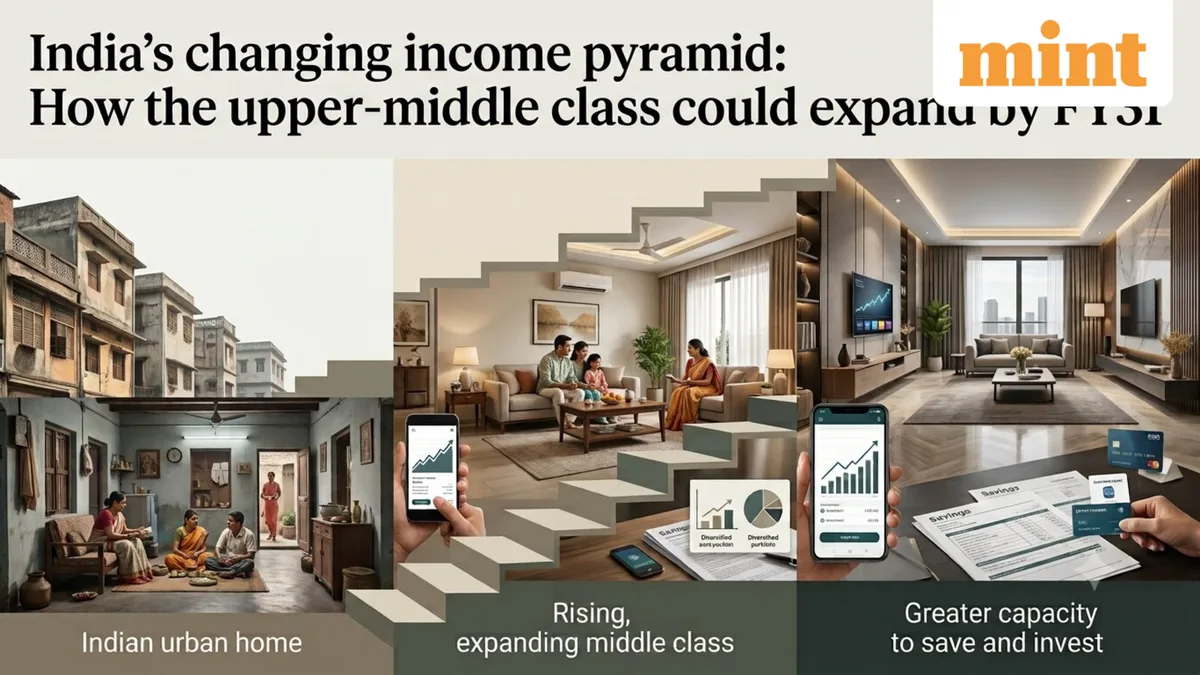
India’s income pyramid is undergoing a significant shift, with millions of households moving from low-income categories into the middle and higher-income brackets.
Data cited in the NSE ’s Red Herring Prospectus (RHP) shows that households earning at least ₹ 8 lakh a year accounted for 34.38% of India’s population in FY26, a share projected to rise to 42.74% by FY31, signalling a widening pool of households with greater capacity for discretionary spending, saving and investing.
The household income data show a clear shift away from the lowest-income category.
*Source: NSE IPO RHP; The crore figures are the estimated number of households, while the percentages are the share of India’s total population represented by each income group.
In FY21, India had about 31.4 crore households, of which 13.5 crore were in the low-income category, earning less than ₹ 3 lakh annually. By FY26, this number had fallen to 11.9 crore and is projected to decline further to 9.8 crore by FY31.
The ₹ 3–8 lakh segment is likely to remain broadly stable. The number of households could rise from 11 crore in FY26 to 11.9 crore in FY31. However, the number of ₹ 8–10 lakh households could rise from 7.4 crore in FY26 to 9.8 crore by FY31, raising their population share from 21.20% to 25.86%.
The high-income segment, with annual household income above ₹ 10 lakh, is also expected to expand significantly, from 4.6 crore households in FY26 to 6.4 crore by FY31. Its share of the population could increase from 13.18% to 16.89%.
Overall, the data points to a clear shift towards higher income brackets, with the ₹ 8 lakh-plus segments together rising from 12 crore households in FY26 to 16.2 crore by FY31.
The movement is not simply about higher consumption. Rising incomes can also increase the amount households can save and invest .
The RHP, citing MoSPI data, notes that household and NPISH (Non-Profit Institutions Serving Households) gross savings reached 21.70% of GDP in FY25.
This financialization is already visible beyond India’s biggest cities. According to the RHP, mutual fund AUM from B30 cities nearly tripled from ₹ 5.36 trillion in March 2021 to ₹ 13.89 trillion in March 2026, while its share of industry AUM rose from 17.06% to 18.86%.
Not entirely. Wealth remains heavily concentrated. The RHP estimates that the top 10% of adults—around 14.6 crore people—held about 65% of total wealth in 2025.
However, the combination of rising incomes, digital access and financial literacy is steadily broadening asset ownership. A larger share of incremental household financial savings is being allocated towards market-linked instruments, reflecting a structural shift from physical to financial assets, as noted.
Disclaimer: This is purely for educational/informational purposes and should not be taken as any sort of investment advice. Always consult a SEBI-registered advisor before making any investment decisions.
5News aggregated this summary from the outlet’s public feed. The full article, with all the context, is on www.livemint.com — the content belongs to LiveMint - Money.