Digital Research's GEM opens a new window on Linux
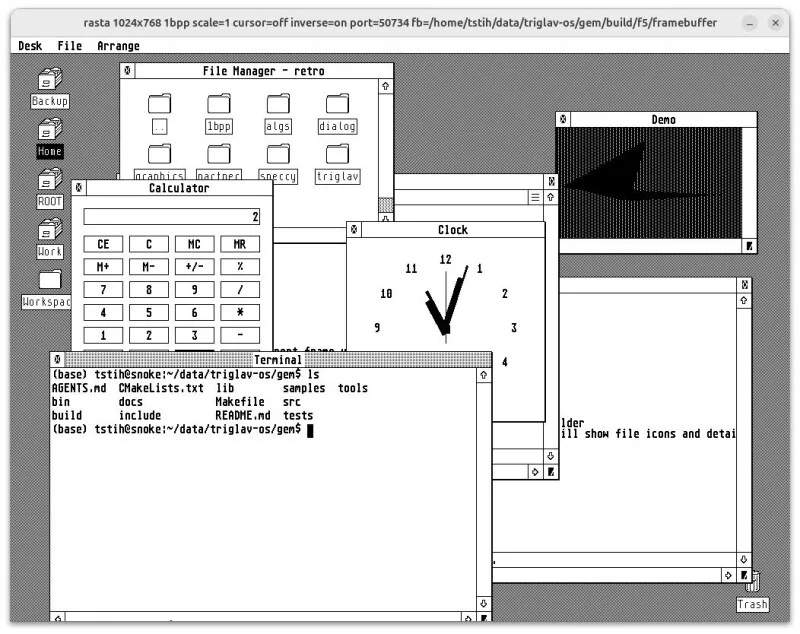
Digital Research's GEM was one of the earliest graphical environments for PC compatibles, and an inspired hack has now resurrected it on Linux.
GEM for Linux is a port of the Atari ST's graphical desktop, created by prolific Slovenian developer Tomaž Štih.
Applications share a display server that can output directly through Linux's framebuffer or display the desktop in a window using Štih's SDL2-based Rasta framebuffer emulator.
In his Linkedin post, he says that it is "derived from OpenGEM and FreeGEM – now secure, optimized, stabilized, and source-compatible with Atari ST GEM." It is derived from the Digital Research GEM source code released by Caldera in 1999, as the still-young Register reported at the time.
GEM was among the first successful GUIs for MS-DOS PC compatibles.
European readers may remember that it was the graphical desktop bundled with the Amstrad PC1512 and PC1640 – the first affordable mass-market PC compatibles on this side of the Atlantic.
In 1985, Apple threatened legal action against Digital Research over GEM's similarity to the Macintosh interface.
Digital Research agreed to make the PC version less Mac-like, removing desktop drive icons, overlapping windows, and other features.
The lawsuit didn't affect Atari's version, however.
That PC version is what Caldera released as open source.
Since 1999, the FreeGEM community has enhanced it beyond the ST version, restoring the removed features and adding others.
These include Bézier curve drawing from the runtime-only GEM/4 bundled with CCP Artline and 3D-shaded buttons from Timeworks Publisher's GEM/5 runtime.
You can see some of the results on John Elliott's FreeGEM page.
As far as we know, this is the second modern FOSS implementation of Atari GEM to benefit from the FreeGEM source code.
5News aggregated this summary from the outlet’s public feed. The full article, with all the context, is on www.theregister.com — the content belongs to The Register.