'There was something bigger in the ground here': Metal detectorist in Germany discovers giant Roman-era hoard from time of emperor Hadrian
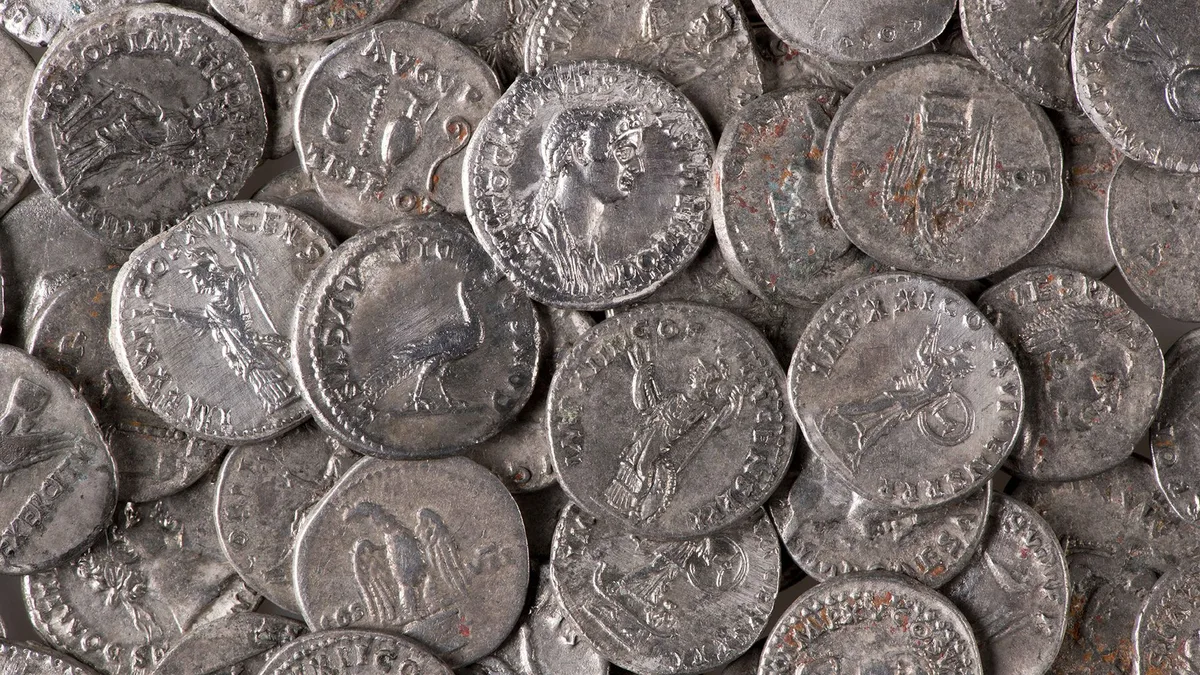
Roman silver coins ever found in that country from the reign of the Emperor Hadrian.
The pile includes more than 900 silver denarii — the denarius was the standard coin of the early Roman Empire — and weighs almost 7 pounds (3.1 kilograms).
The stash was discovered about a year ago in a field near the small city of Wesseling, a few miles south of Cologne, according to a translated statement from Germany's Rhineland regional government.
It's now on display at the Rhineland Regional Museum in Bonn (LVR-Landesmuseum Bonn).
Archaeologists think the hoard was buried at the time of the Emperor Hadrian, who ruled from A.D.
117 to 138, because the most recent coin was minted in 124 or 125.
But the coins span more than three centuries: the oldest was minted in 148 B.C., during the time of the Roman Republic ; while most of them are from the time of the Flavian emperors — Vespasian and his sons, Titus and Domitian — from A.D.
69 to 96.
The coins span more than 300 years.
The earliest were minted during the Roman Republic and the latest coin dates to the reign of the Emperor Hadrian. (Image credit: Marcel Zanjani/LVR-Office for the Preservation of Archaeological Monuments in the Rhineland) Silver signal The statement praised the metal detectorist, Oliver Riedl, who found the hoard and stopped digging after unearthing 15 of the coins.
At that point, his metal detector signaled that something much larger was hiding underground.
"It was clear to me that there was something bigger in the ground here," Riedl said in the statement.
"I therefore immediately informed the office." Riedl is licensed by the state to use his metal detector and has been trained by regional archaeological authorities, the statement said. ( Illegal metal detectorists also operate in Germany, but are known to often disrupt the archaeological value of their finds).
Archaeologists from the Rhineland regional government soon investigated the find and excavated the entire hoard of 934 Roman silver coins.
5News aggregated this summary from the outlet’s public feed. The full article, with all the context, is on www.livescience.com — the content belongs to Live Science.