James Webb telescope pinpoints the most distant 'fast radio burst' ever seen
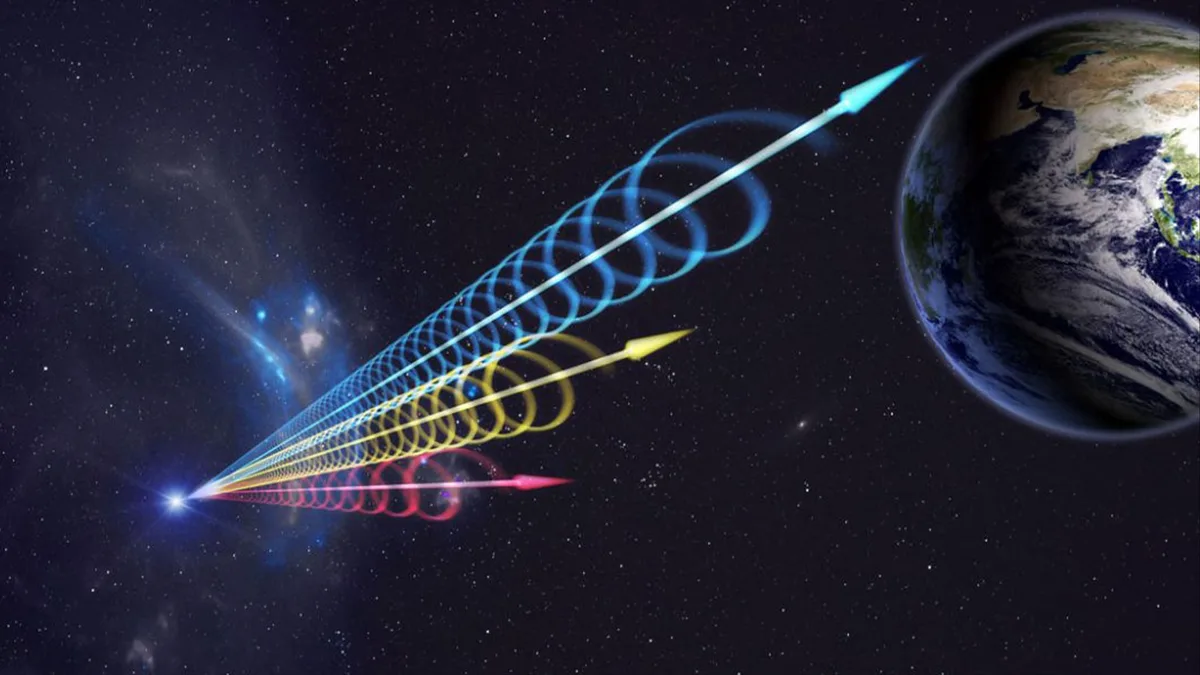
Astronomers have detected the most distant burst of radio signals ever seen: an explosion that's emitting waves of energy from more than 10 billion light-years away.
The event, named FRB 20240304B, is known as a fast radio burst (FRB).
Astronomers have detected thousands of FRBs before this.
But because these events last only milliseconds, they are extremely difficult to study and their origin stories remain unclear.
In this case, however, astronomers managed to use a radio telescope array and the James Webb Space Telescope (JWST) to chart the event, with JWST narrowing down the precise host galaxy that FRB 20240304B came from.
The study, published Thursday (Oct.
8) in the journal Science , sheds more light on a time when the universe was only about 3 billion years old, showing that FRBs arose early in our cosmos' history.
The detection more than doubles the previous distance record for FRBs.
The JWST played an instrumental role in the discovery, study co-author Themiya Nanayakkara , a senior lecturer at the Sydney Institute for Astronomy, told Live Science in an email.
The email was written in collaboration with study first author Manisha Caleb , a senior lecturer in astrophysics at the same university.
For example, JWST's observations showed that the host galaxy was smaller than expected, was "metal-poor" (had few elements besides hydrogen and helium), and was forming a lot of stars.
These characteristics could offer new clues about the environments in which FRBs arise, giving more information about the mysterious events.
Researchers suggest that this FRB may have been linked to a magnetar, a highly magnetic star core left after a supernova.
Zooming in with the James Webb telescope The ancient FRB was initially detected with MeerKAT, an array of 64 radio telescopes in South Africa.
5News aggregated this summary from the outlet’s public feed. The full article, with all the context, is on www.livescience.com — the content belongs to Live Science.