Astronomers spot the closest, fastest star ever seen orbiting our galaxy's monster black hole
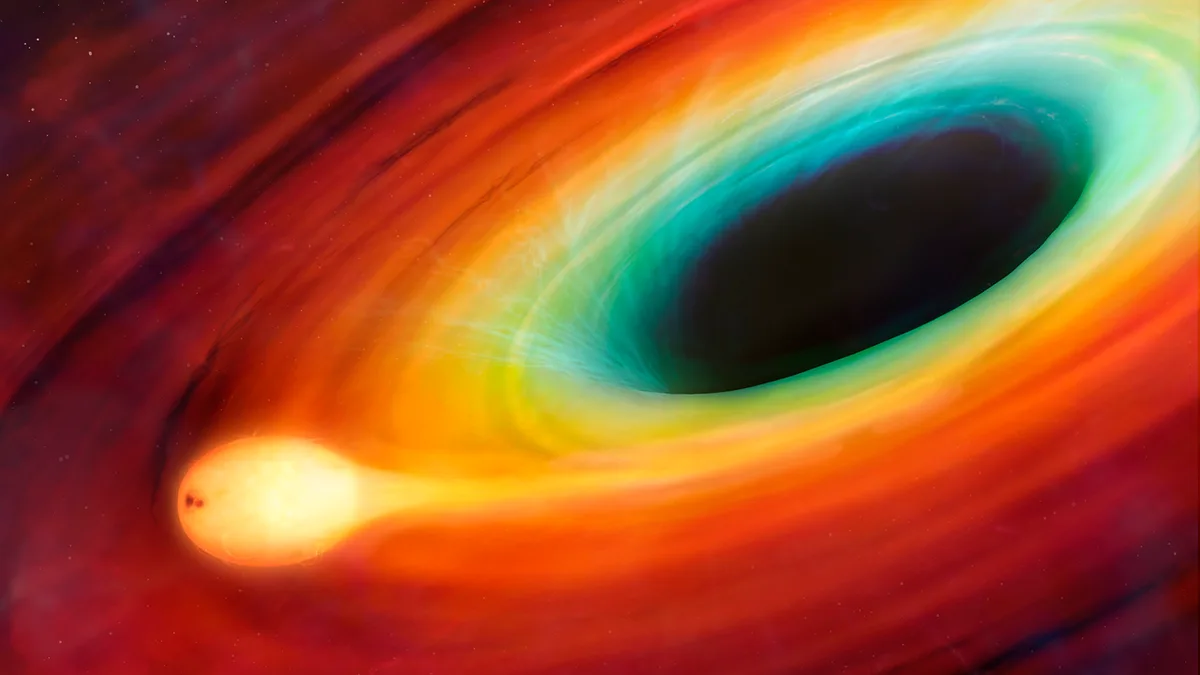
Astronomers have discovered the closest, fastest star ever seen orbiting Sagittarius A* (Sgr A*), the 4.3 million-solar-mass black hole at the heart of our galaxy.
The faint star, named S301, completes a lap every 8.7 years and skims past the black hole at roughly 55 million mph (90 million km/h) — about 8% the speed of light.
Its orbit is so tight that, within about a decade, researchers should be able to measure its spin rate.
The discovery was reported Aug.
19 in the journal Nature .
Stars as lanterns in warped space The center of the Milky Way , some 27,000 light-years away, is one of the best natural laboratories physicists have.
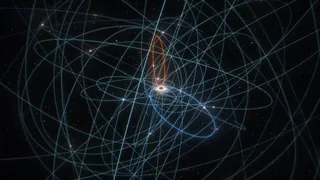
A few dozen stars swarm the galaxy's central black hole on tight orbits, and because gravity there is far stronger than anywhere else we can watch closely, those stars behave in ways Isaac Newton never anticipated.
"Stars orbiting Sgr A* are very interesting objects, as they serve as luminous probes of the curved spacetime around the black hole," study co-author Felix Mang , a doctoral student at the Max Planck Institute for Extraterrestrial Physics in Germany, told Live Science via email.
Until now, the star doing most of that work was S2, a bright star on a 16-year orbit.
Astronomers have followed S2 since 1992, through more than two full laps, and that tracking revealed two hallmark predictions of Einstein's theory of general relativity : light from the star losing energy as it climbs out of the black hole's gravity well, and the slow rotation of its elliptical orbit, known as Schwarzschild precession.
Those effects depend only on the black hole's mass.
But black holes have a second property: rotation.
A spinning black hole drags the fabric of space around with it, like a spoon stirring honey.
That effect fades extremely quickly with distance, so measuring rotation requires a star that dives much closer to the black hole than S2 ever does.
5News aggregated this summary from the outlet’s public feed. The full article, with all the context, is on www.livescience.com — the content belongs to Live Science.