'She knew she had something really important on her hands': Rosalind Franklin figured out DNA's helical structure before Watson and Crick, study suggests
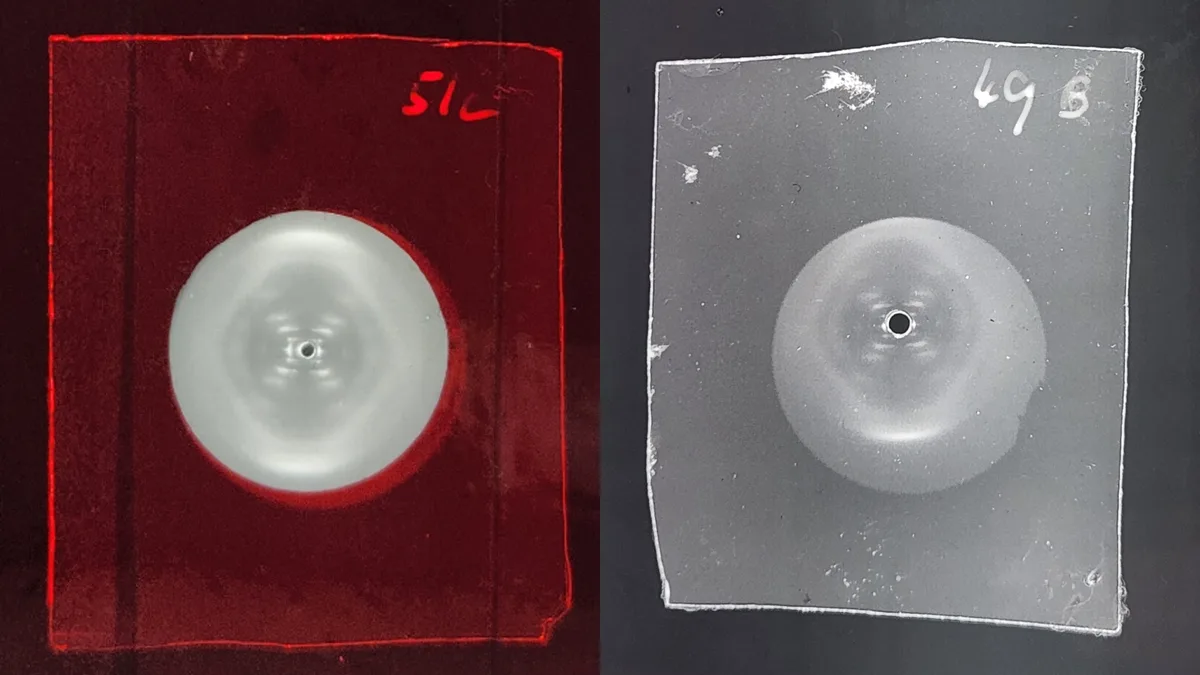
Rosalind Franklin, whose photographs of the molecular structure of DNA led to a 1962 Nobel Prize for three other scientists, knew that her famous images held the secret of the double helix, new research suggests.
An examination of archival material reveals that Franklin's Photograph 51 , which was taken in May 1952 and later published to show the double-helix structure, was specifically taken for the purpose of publication — not, as some narratives have held, an experimental shot that Franklin believed was insignificant.
The new research revealed that Photograph 51 was a new exposure of a sample Franklin had already photographed.
She started Photograph 51 the same day she saw that photograph, Photograph 49.
"She took it because she wanted to get a really refined version," said study co-author Alistair Sponsel , a historian of science at the Science History Institute in Philadelphia.
Making the effort to take a better photograph of the same sample is "a sign she knew she had something really important on her hands," Sponsel told Live Science.
Francis Crick, James Watson and Maurice Wilkins shared the Nobel Prize in Medicine for the discovery of the double-helix structure of DNA in 1962.
As Watson told it in his 1968 autobiography, "The Double Helix: A Personal Account of the Discovery of the Structure of DNA," Franklin's photographs were his "aha" moment: "The black cross of reflections which dominated the picture could only arise from a helical structure," he wrote.
Rosalind Franklin (1920-1958) first took Photograph 49 and then Photograph 51, clues that she was aware of DNA's helical structure. (Image credit: Donaldson Collection via Getty Images) Watson further implied that Franklin was a laboratory automaton, good at the X-ray crystallography techniques used to capture the images of the DNA molecule but bad at interpreting her own data.
The new archival work, published Monday (Oct.
5) in the Journal of the History of Biology , suggests otherwise.
Franklin's dearth of published notes about Photograph 51 has been used to suggest she missed a major discovery.
But Sponsel said her journals show she noted the possible helical shape and rich structural data in her notes for her first picture of the sample, Photograph 49, which she followed up with the more refined image in Photograph 51.
"In Franklin's mind, they were two different types of scientific image," Sponsel said.
5News aggregated this summary from the outlet’s public feed. The full article, with all the context, is on www.livescience.com — the content belongs to Live Science.