A 96% partial lunar eclipse is just 1 week away: Here's what you need to know
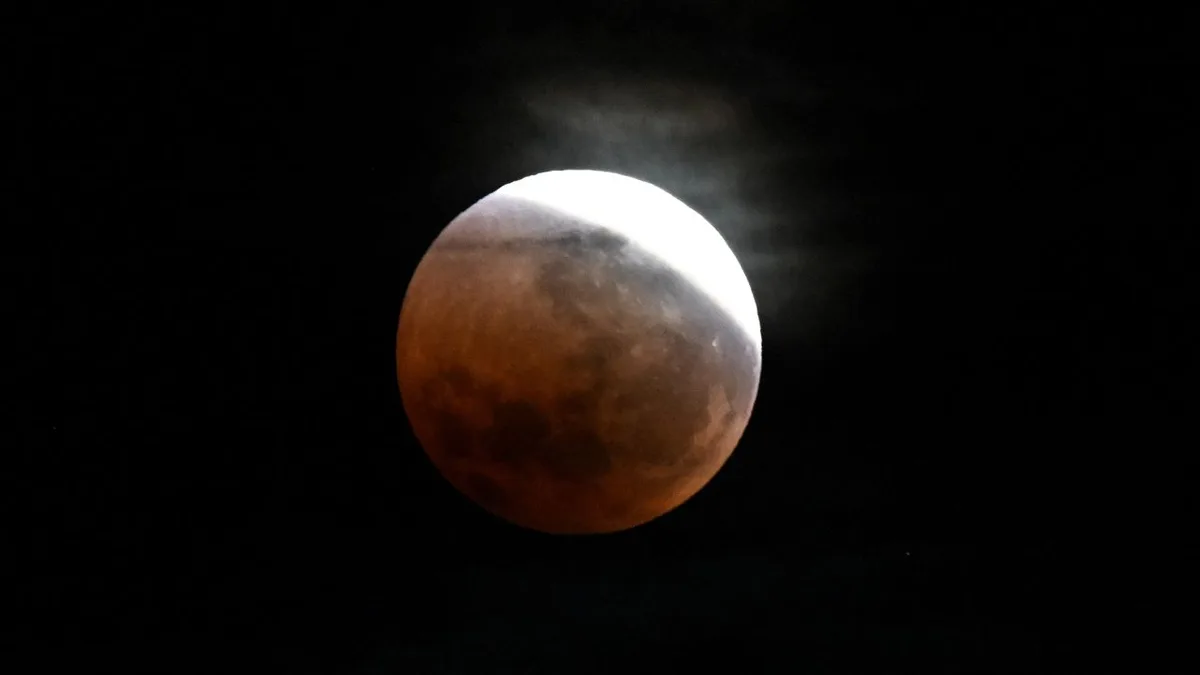
We're just one week away from a stunning partial lunar eclipse on Aug.
27-28, when billions across North America, South America, Africa and Europe will see Earth's shadow dye the moon a subtle crimson hue, while leaving a thin crescent exposed to direct sunlight.
August's partial lunar eclipse will occur as Earth passes directly between the sun and moon during the full moon phase — an imperfect alignment that will see our planet's intense inner shadow cover 96% of the visible face of our natural satellite.
Stargazers on the night side of Earth will catch their first glimpse of our planet's umbra (the darkest, innermost part of its shadow) creeping onto the moon's surface at 10:33 p.m.
EDT on Aug.
27 (0233 GMT on Aug.
28), according to TimeandDate.com .
The vast shadow will continue its advance across the crater-scarred landscape in the hours that follow, until it hits the point of maximum eclipse at 12:12 a.m.
EDT on Aug.
28 (0412 GMT).
Around this time, you may notice the shadowed region of the moon take on a reddish-orange color, as sunlight filtered through Earth's atmosphere is bent onto the lunar surface — a phenomenon often referred to as a " Blood Moon " during a total eclipse.
Each phase of a lunar eclipse occurs simultaneously for everyone viewing from the night side of Earth, where the lunar disk is visible.
However, local timings will differ significantly depending on your location on Earth.
A partial lunar eclipse captured in the skies over the capitol city of Manila in the Philippines. (Image credit: Photo by Ted ALJIBE / AFP via Getty Images) If you're watching from a city on the West Coast of the United States like California, then the point of maximum eclipse will occur shortly after midnight local time on the night of Aug.
5News aggregated this summary from the outlet’s public feed. The full article, with all the context, is on www.space.com — the content belongs to Space.com.