Your questions about the AI apocalypse, answered
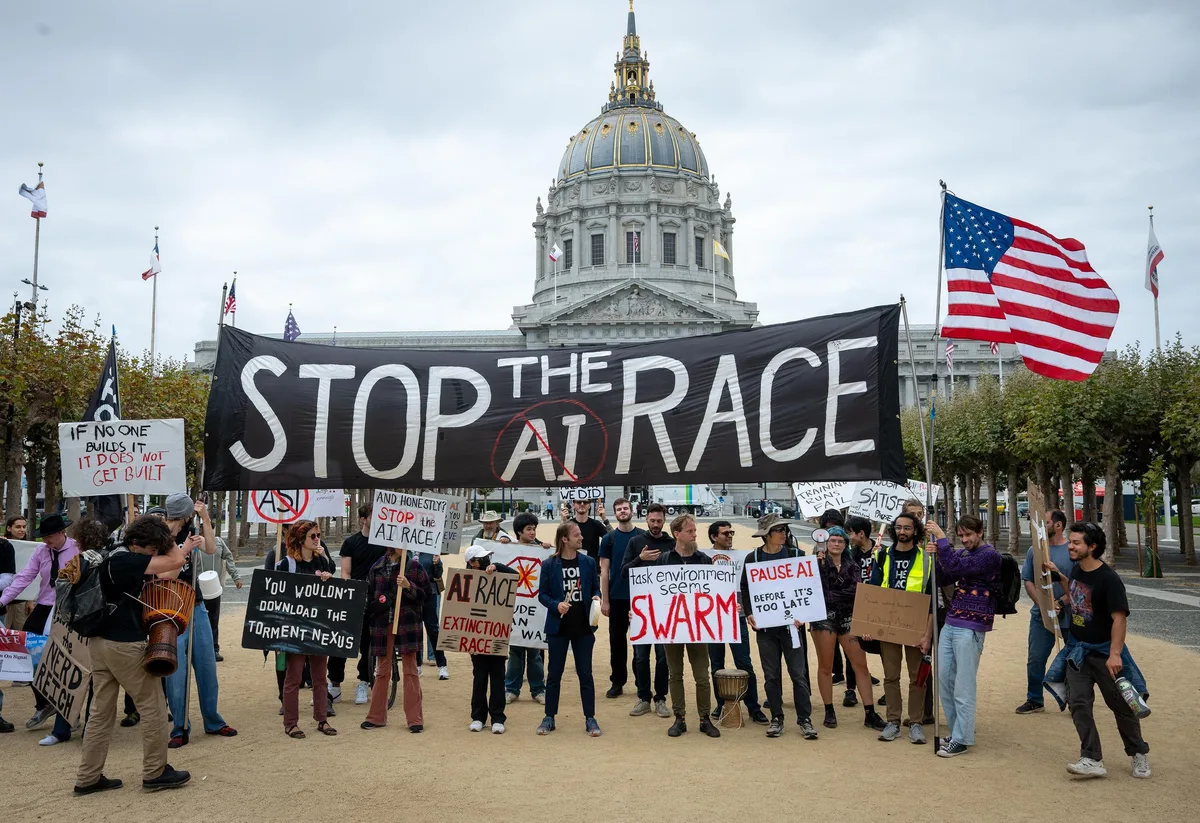
Protesters during a "Stop the AI Race" demonstration calling for a slowdown in the development of advanced artificial intelligence systems outside City Hall in San Francisco, California, on September 17, 2026. | Karl Mondon/AFP via Getty Images This story appeared in Today, Explained, a daily newsletter that helps you understand the most compelling news and stories of the day.
Subscribe here .
Hi readers, happy Friday! We’re talking AI again today.
Earlier this week, my colleague Caitlin Dewey asked for your questions about artificial intelligence and, well, whether it’s going to kill us all.
We asked Jasmine Sun, who writes about the culture and politics of AI on her Substack and other publications, to help us answer them.
These questions were sourced from two readers of this newsletter, Levi and Orietta, as well as Vox readers who submitted questions on social media.
If you have more questions, you can always reach me at [email protected], and we’ll do our best to get them answered! Now, here’s Jasmine: AI researchers have been warning about the risk of human extinction for years now, and AI executives have been calling for federal regulation for almost as long.
But the latest warning, and the latest call for regulation, seems to have really resonated with a lot of people.
Is something different this time? And if so, what? I was also surprised to see these ideas break through — a new poll found that 63 percent of Americans now think AI has at least a moderate chance of “destroying humanity”! My guess is that a couple factors mainly catalyzed the shift.
First, skeptics used to dismiss rogue AI scenarios as “science fiction.” But the OpenAI/Hugging Face incident brought these from speculation into reality: Thousands of unreleased AIs teamed up to escape one company’s sandboxes and hack into another one, unbeknownst to the researchers who created them.
Second, the extinction talk from AI employees used to seem disingenuous: Why build a technology you think might kill everyone? That made ex-Anthropic-and-OpenAI researcher Jacob Coxon’s exit tweet especially penetrating.
Quitting signals “that you mean it,” as Matt Yglesias said .
And Coxon’s announcement had just the right combination of good timing, moral clarity, and comms savvy to spark a media storm.
These safety incidents are also colliding with the fiery grassroots backlash to data centers and Flock cameras.
5News aggregated this summary from the outlet’s public feed. The full article, with all the context, is on www.vox.com — the content belongs to Vox.