Microscopic fragments of ancient alien tech may litter the moon — and scientists have a plan to find them
Tiny fragments of ancient alien tech may be strewn across the surface of the moon , and it may be relatively easy to find these microscopic relics, scientists propose in a new study.
The theoretical study does not claim to have found any evidence of advanced alien civilizations; rather, it offers a new way to search for clues of their existence.
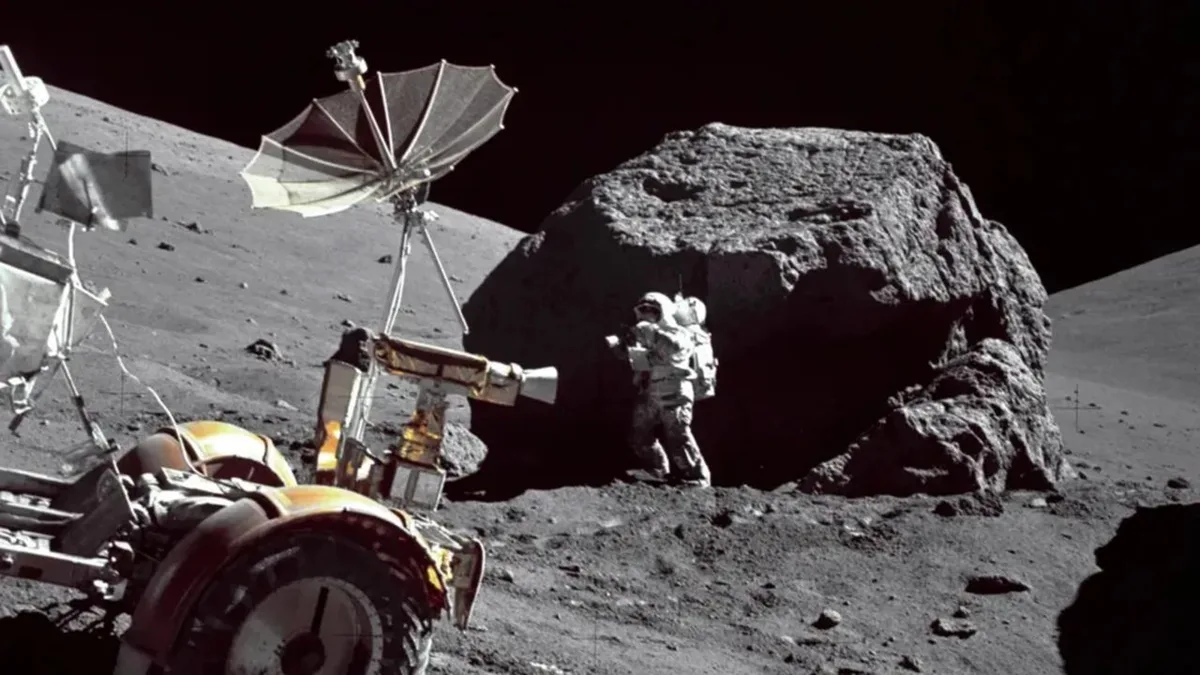
Unlike Earth, the moon has no functional atmosphere or magnetic field, so it is completely exposed to the vacuum of space.
As a result, it is constantly bombarded by meteorites , as well as hit by a steady stream of microscopic particles from the rest of the solar system and beyond.
Because the moon has no water or tectonic movements, this microscopic matter accumulates and remains on the surface, completely undisturbed.
In the new paper, uploaded June 23 to the preprint server arXiv , the researchers argue that some of this dust originates from star systems beyond our own and, therefore, may contain evidence of long-lost alien civilizations.
They also propose a new experiment that could potentially find these microscopic fragments within samples collected over the next decade or more. (The study has not been published yet, but it has been submitted to the International Journal of Astrobiology.) "The moon has been quietly accumulating material from space for billions of years, much of it likely billions of years older than the moon itself," study first author Lewis Pinault , a planetary scientist at University College London and an affiliate of the SETI Institute, said in a statement .
"We're asking whether that ancient collection might contain microscopic traces of technologies that existed long before humans ever looked up at the sky." Unlike Earth, the moon lacks a functional atmosphere or magnetic field, meaning that its surface is exposed to the vacuum of space.
This allows cosmic dust and other tiny particles to embed themselves within the lunar regolith. (Image credit: NASA) Tiny technosignatures Until now, the search for evidence of advanced alien civilizations, known as technosignatures, has focused mainly on radio signals that could be emitted from inhabited exoplanets or hypothetical megastructures, such as Dyson spheres .
However, these signals would originate only from active civilizations, not those that died out long before we could spot them.
The authors of the new study argue that when a civilization dies, traces of its technology could survive and end up in space, either via the deterioration of megastructures and other smaller spacecraft or via powerful asteroid strikes on once-inhabited exoplanets.
Once in space, tiny specks of metal or other artificial materials could be ejected from star systems by powerful gusts of stellar wind and eventually drift toward us.
5News aggregated this summary from the outlet’s public feed. The full article, with all the context, is on www.livescience.com — the content belongs to Live Science.