Cool chemistry trick allows new tattoos to 'turn on and off'
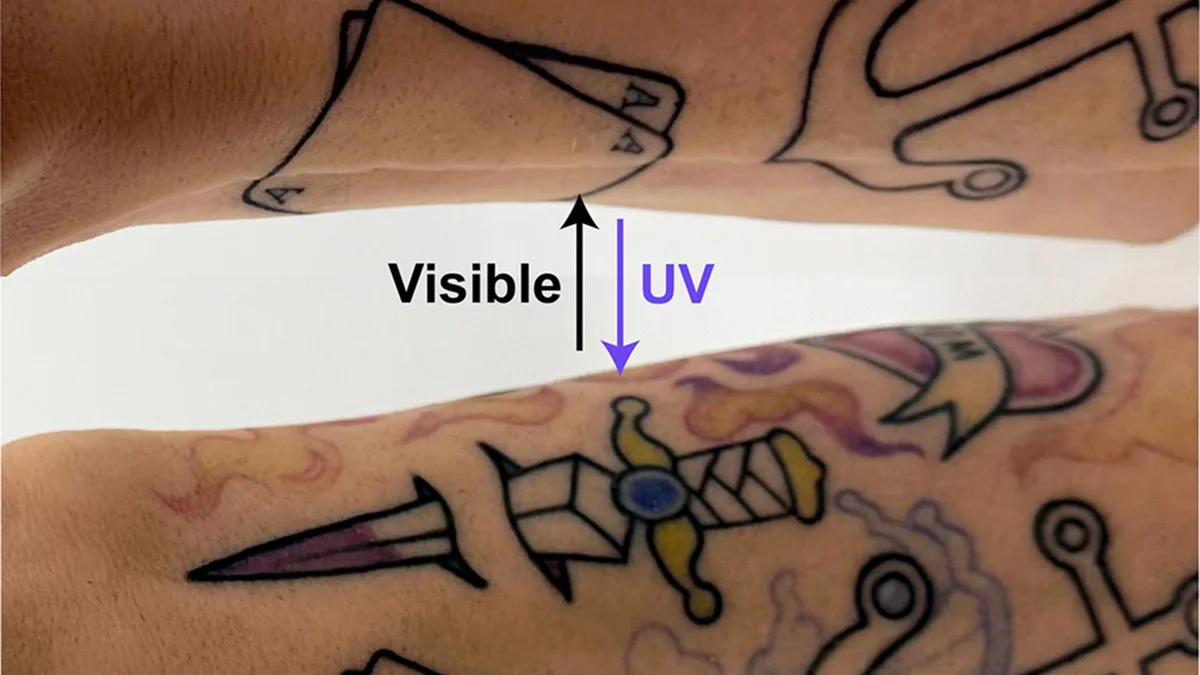
The new tattoo ink is activated under UV light. (Image credit: Matter & Light, Bruns et al.) Researchers have developed a new type of tattoo ink that can be switched on and off with light, allowing colors and images embedded in the skin to be changed and even "erased" without having to go through the painful tattoo-removal process .
The system, which is being commercialized under the name PhotoTat, could eventually give people a way to conceal or change permanent body art.
It could also have more practical applications, including medical tattoos that are visible only when a doctor needs to see them, researchers reported in a study published Friday (Oct.
9) in the journal Matter & Light .
"This is a tattoo that you can have, and whenever you decide you don't want it to be showing anymore, or you just don't want it there, you just turn it off," said study co-author Carson Bruns , an associate professor of biomedical engineering at the University of Colorado at Boulder.
"And that's it.
You don't have to turn it on again." Working like a light switch PhotoTat contains three primary color inks — blue, magenta and yellow — made with photochromic dyes , which are light-sensitive compounds that can change color with different wavelengths of light.
These dyes are encapsulated in nanoparticles of polymethyl methacrylate (PMMA) — a medical-grade, glass-like plastic that is already used in medical implants and dermal fillers.
The dyes change their molecular structure when exposed to specific wavelengths of light.
A 365-nanometer ultraviolet (UV) LED can activate pigments in around two to three seconds, Bruns said.
Once activated, the colors can persist for hours to days under typical indoor lighting.
But once the wearer exposes their skin to the bright outdoor sun, the colors disappear in seconds, erased by the intense light.
That makes the tattoo unique, as the pigment itself remains in the skin but the tattoo's appearance changes.
Bruns and his team found that all three PhotoTat channels remained switchable in the skin for between 1.4 and 2.2 years.
5News aggregated this summary from the outlet’s public feed. The full article, with all the context, is on www.livescience.com — the content belongs to Live Science.