'It looks like a chimera' — 168 million years ago, a strange platypus-like mammal relative lived in China alongside dinosaurs
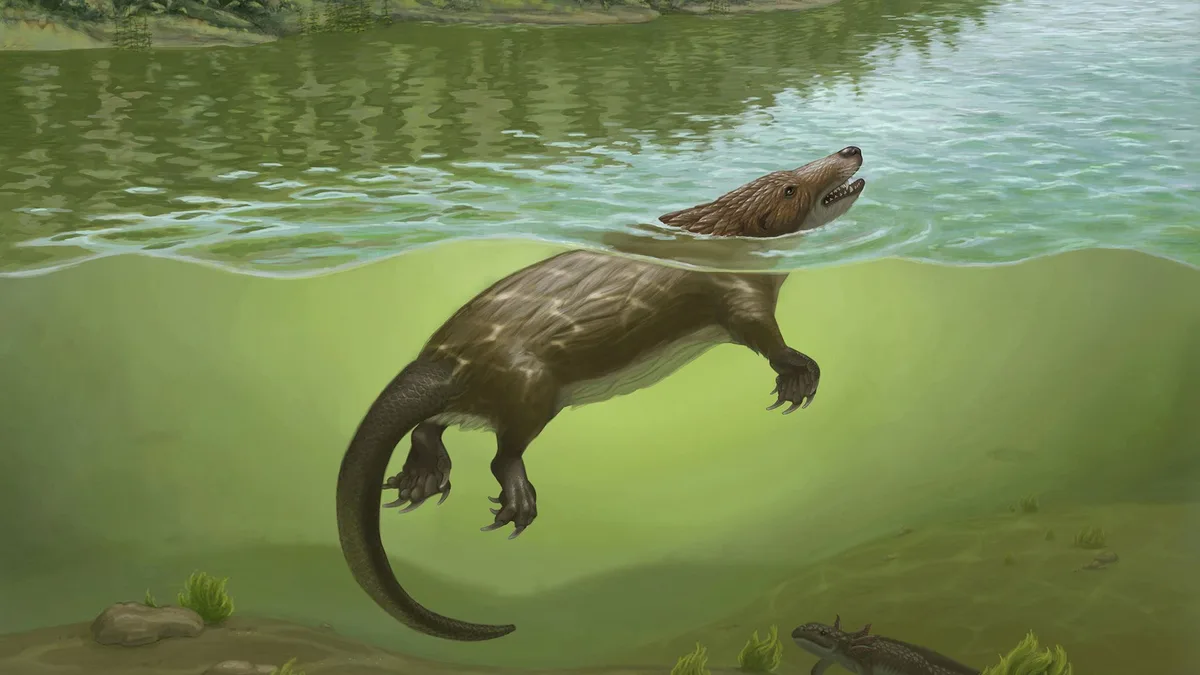
A newly discovered platypus-like creature is the largest-known mammal relative from the entire Jurassic period, a new study finds — although it still only weighed as much as a Chihuahua.
The critter, which hunted salamanders in the freshwater lakes and rivers of what is now Inner Mongolia, China, lived during the mid-Jurassic between 168 million and 163 million years ago.
It seems to be the earliest known mammal-type animal that lived a semiaquatic life.
Researchers unearthed the delicate and detailed fossil in 2016, which revealed that the animal likely weighed about 2.2 to 4.4 pounds (1 to 2 kilograms).
It was large for a mammal relative during the Jurassic, but its name, Megacauda sungei, was inspired by its tail: Megacauda means "big tail." The discovery was detailed in a study published on Wednesday (Oct.
7) in the journal Nature .
The furry predator had a mix of features seen in modern-day animals, with a broad, flattened tail that marks it as a powerful swimmer, and short hind legs with relatively long feet.
"It's like a chimera," study co-author Zhe-Xi Luo , a paleontologist at the University of Chicago, told Live Science.
"The back half of this animal is very much like a platypus .
As are the limbs, which would be capable of swimming or digging tunnels in river banks." But the teeth "are definitely not like a platypus," Luo said.
It possessed robust canines and shearing cheek-teeth that would cut and chew meat in a different way from modern carnivorous mammals.
"It's a predator with gigantic and very specialized canines," Luo said.
"So, it's partly otter-like and partly platypus-like." A revealing fossil The fossil of Megacauda sungei , highlighting its bones and soft tissue. (Image credit: Luo et al., Nature (2026)) Tiny bits of vertebrate bones found in what would have been the animal's stomach and the surrounding fossil beds hint that M. sungei dined on salamanders, Luo said.
He added that M. sungei may have sheltered in burrows on land in the temperate plant-filled climate, and hunted in lakes and rivers for fish and invertebrates.
5News aggregated this summary from the outlet’s public feed. The full article, with all the context, is on www.livescience.com — the content belongs to Live Science.