The central Pacific Ocean just broke a temperature record. Experts say it might signal a new kind of El Niño.
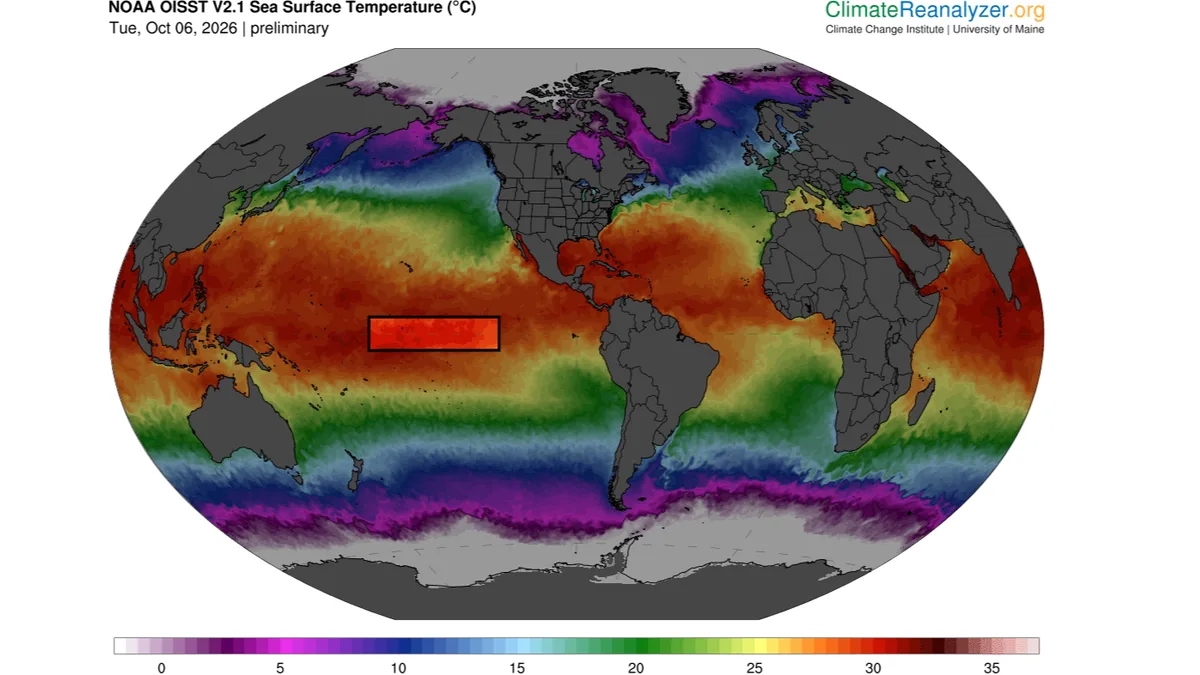
The sea surface temperature in a key section of the central equatorial Pacific Ocean has now surpassed all previous temperatures on record for this region, exceeding 86 degrees Fahrenheit (30 degrees Celsius) for the first time, according to preliminary data released Monday (Oct.
5).
Specifically, these temperatures occurred in the Niño 3.4 region, located between 5 degrees north and 5 degrees south latitude, and 120 degrees west and 170 degrees west longitude.
Researchers use this region to monitor the progression of El Niño , the warm phase of a multiyear natural climate pattern that's currently in full swing and steadily intensifying.
But how significant is this new record, and could it be a harbinger of increasingly extreme El Niño events in the future? At this time of the year, sea surface temperatures above 86 F are common in the western Pacific warm pool, a mass of water located northeast of Australia.
But the Niño 3.4 region is nowhere near the warm pool and usually has much cooler temperatures.
This latest data indicates "an exceptionally warm state for this part of the tropical Pacific," said Jin-Yi Yu , a professor of Earth system science at the University of California, Irvine.
"If the reported daily El Niño 3.4 temperature above 30°C is verified in the observational dataset, it would be an extraordinary record," Yu told Live Science in an email.
Other experts agreed.
A Niño 3.4 sea surface temperature above 86 F is a "very significant" new record, Timothy Osborn , a professor of climate science and the director of the Climatic Research Unit at the University of East Anglia in the U.K., told Live Science in an email.
Mat Collins , a professor of climate systems and the head of mathematics and statistics at the University of Exeter in the U.K., also called the temperature "very significant" in an email to Live Science.
But it's important to note that absolute temperature is not the standard way of measuring the strength of El Niño, Osborn said.
Researchers usually assess El Niño intensity by comparing sea surface temperatures in the Niño 3.4 region with the average conditions there or with sea surface temperatures across the rest of the tropics, with the latter method removing a skew in the data caused by the climate-change-induced heating of oceans globally.
"On those measures, the current event is already close to being the strongest [El Niño] on record and will likely soon exceed previous records given that the event is forecast to strengthen further," Osborn said.
5News aggregated this summary from the outlet’s public feed. The full article, with all the context, is on www.livescience.com — the content belongs to Live Science.