Scientists study 3,000 supernovas and discover that dark energy may be evolving
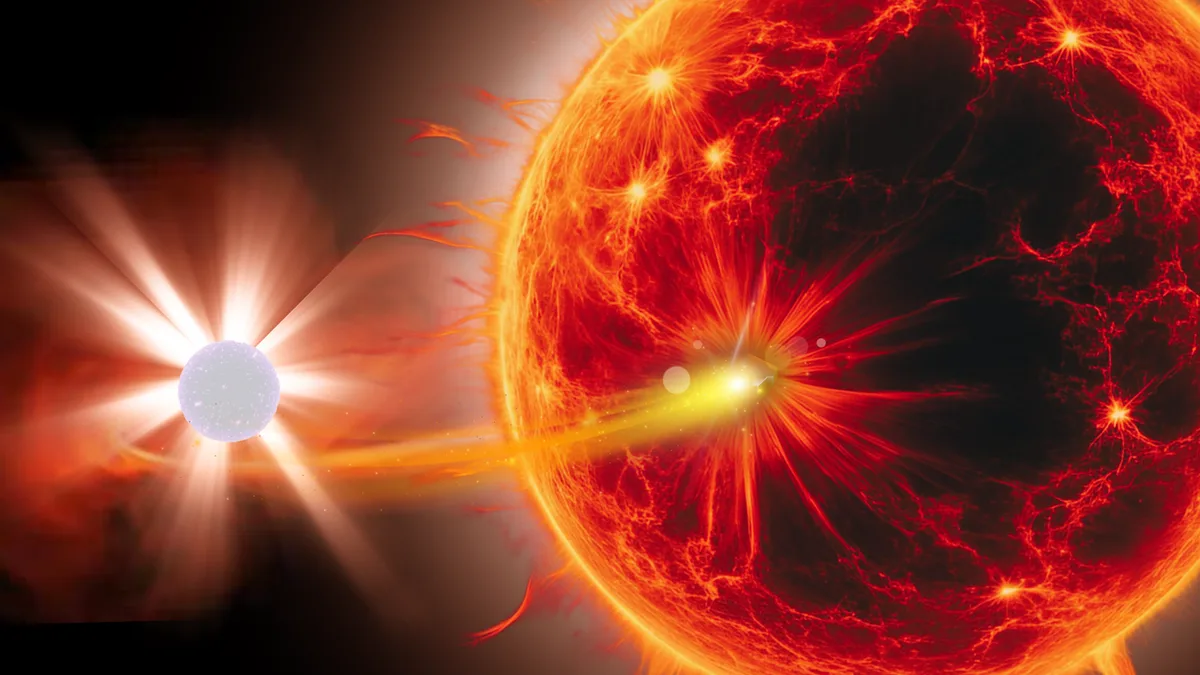
A catalog of almost 3,000 white dwarfs that exploded as type Ia supernovas after overfeeding on companion stars indicates that dark energy, the mysterious force accelerating the expansion of the universe, is changing over time.
The discovery, in conjunction with data from the Dark Energy Survey (DES), backs results revealed from the Dark Energy Spectroscopic Instrument (DESI) published in 2024 that suggested dark energy's influence is weakening.
That means that the team's research doesn't just involve the most comprehensive catalog of type Ia supernovas ; it presents the clearest picture yet of the evolution of the universe and the influence of dark energy.
"We've rebuilt 3 decades of astronomical observations into a single, consistent framework," team member Ryan Camilleri of the University of Queensland said in a statement.
"We combined our data with other cosmic measurements, including relic light from the Big Bang and maps of how galaxies are distributed through space.
"Instead of confirming the standard model of cosmology, which assumes dark energy is fixed and unchanging, we have more evidence that dark energy may change over time." How do exploding white dwarfs tell us about dark energy? White dwarfs are the smoldering stellar remnants that are left over when stars with around the mass of the sun exhaust the fuel for nuclear fusion in their cores.
This ends the outward pressure that supports a star against its own gravity, meaning the star's core collapses as the outer layers are shed.
The core becomes a white dwarf, and for single stars, that is the end.
But around 50% of sun-sized stars have a binary companion , and this can lead to renewed activity and a change in the star's fate.
If the white dwarf and its companion are close enough together, the dead star begins stripping away the outer layers of its companion.
As this material builds on the white dwarf, it pushes the stellar remnant's mass over the so-called Chandrasekhar limit , allowing it to go supernova.
These cosmic explosions are called type Ia supernovas, and their light output is so uniform that these events are referred to as standard candles.
They are of vital importance because measuring how their light has been redshifted as it travels means type Ia supernovas can be used to measure cosmic distances.
"Over the years we've learned a lot more about how supernovae behave so we've been able to go back and apply that improved understanding to older data," Camilleri said.
5News aggregated this summary from the outlet’s public feed. The full article, with all the context, is on www.space.com — the content belongs to Space.com.