Bronze ring with Lighthouse of Alexandria engraving discovered at palace on submerged island in Egypt
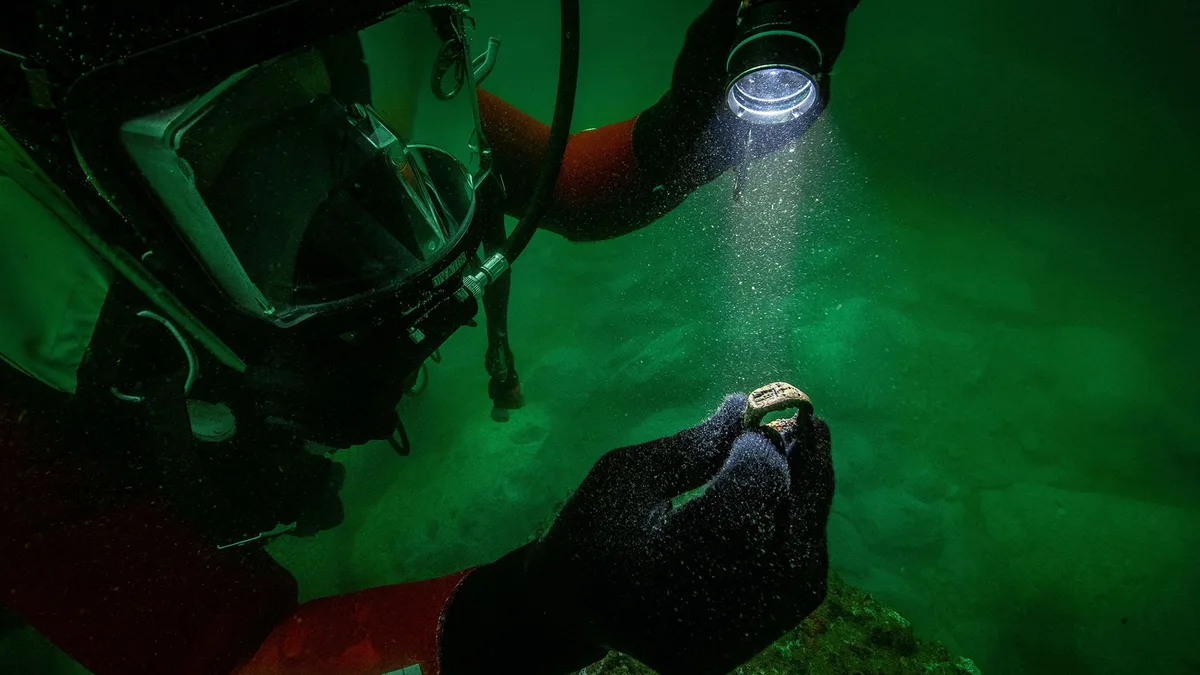
A bronze signet ring depicting the Lighthouse of Alexandria, a wonder of the ancient world , has been discovered underwater in the Mediterranean off Alexandria, Egypt.
A joint team from the European Institute for Underwater Archaeology (IEASM) and the Egyptian Ministry of Tourism and Antiquities found the artifact in the remains of a palace on the now-submerged island of Antirhodos, marking the first time a signet ring featuring the image of the lighthouse has been found, the IEASM team said in a statement.
The image on the ring is similar to depictions of the lighthouse that have been previously found on coins dating to the second century, representatives of IEASM said.
"The discovery of the ring-signet is even more important as it has been excavated in the legendary palace of the Island of Antirhodos, that once was a centre of power," Franck Goddio , president of IEASM, said in the emailed statement.
The palace was used by Egyptian pharaohs who reigned during the Ptolemaic period (304 to 30 B.C.), a dynasty of rulers descended from one of Alexander the Great's generals.
The lighthouse was built on the island of Pharos around 280 B.C. and stood more than 328 feet (100 meters) tall.
Some ancient writers, such as Pliny the Elder, considered it among the wonders of the world, and it continued to be used into the Middle Ages, until earthquakes and erosion resulted in its destruction and disappearance beneath the sea.
While the lighthouse was modified over time, it would have had a statue, possibly of Zeus, at the top holding an oil lamp that helped guide mariners.
The newly discovered bronze signet ring has an image depicting the Lighthouse of Alexandria. (Image credit: Christoph Gerigk©Franck Goddio/Hilti Foundation) Whoever was wearing a signet ring could have used it to make an impression on soft materials, such as clay and wax, to create a seal.
The discovery of the ring in the remains of the palace at Antirhodos suggests that the palace was used for administrative functions related to the lighthouse, representatives of IEASM said in the statement.
Even though the ring's engraving is somewhat worn, it likely depicts the lighthouse, said Doris Behrens-Abouseif , a professor emeritus of history of art and archaeology at the University of London who has written about the lighthouse but was not part of the research team.
There are "thousands of coins from Alexandria showing a similar depiction of the lighthouse," she told Live Science in an email.
Those coins date to the Ptolemaic or Roman (29 B.C. to A.D.
395) periods, she noted.
5News aggregated this summary from the outlet’s public feed. The full article, with all the context, is on www.livescience.com — the content belongs to Live Science.