Explosive 'Mountain of God' spits out the fastest-flowing lava on Earth — Earth from space
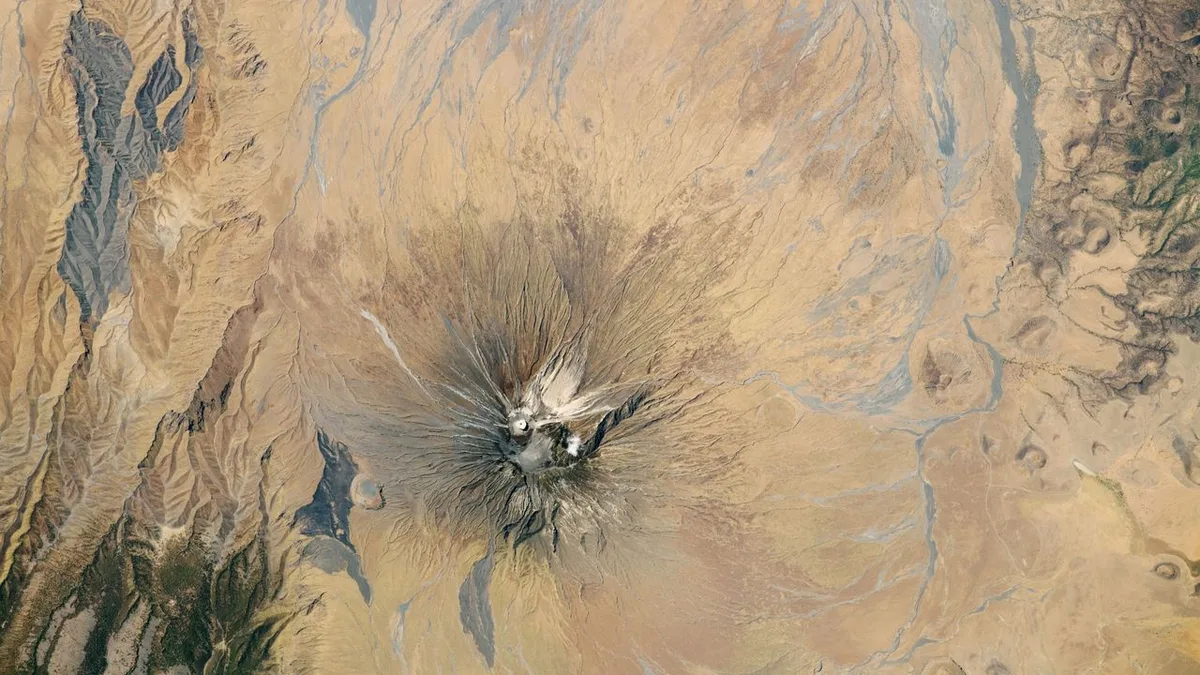
QUICK FACTS Where is it? Ol Doinyo Lengai, Tanzania [ -2.7734503796, 35.91519798 ] What's in the photo? The lava-stained slopes and ash cone of a highly active volcano Who took the photo? An unnamed astronaut on board the International Space Station When was it taken? Oct.
6, 2020 This dramatic astronaut photo shows a highly active stratovolcano in Tanzania that was recently adorned with a striking white "crown" of ash.
The explosive volcano produces a rare type of lava that is unusually cool, uniquely colored and the fastest-flowing on Earth.
The volcano is officially named Ol Doinyo Lengai and stands up to 9,718 feet (2,692 meters) above the grassy plains of the Arusha region of northern Tanzania.
The local Maasai people call the towering peak the "Mountain of God," because they believe it is the residence of the supreme creator god Ngai (also known as Engai or Enkai), according to the book " Sacred Mountains of the World " (Cambridge University Press, 2022).
Ol Doinyo Lengai is one of Africa's most active volcanoes; it has been erupting on and off for the past 15,000 years.
It alternates between effusive eruptions, where lava seeps out of its vents, and sporadic explosive outbursts, which can drastically alter its appearance.
Its most recent eruption, which is effusive, has been going on since April 2017, according to the Smithsonian Institution's Global Volcanism Program .
The sacred mountain produces a rare type of lava that consists of natrocarbonatite rock, which is rich in sodium, potassium and calcium carbonate but low in silica.
As a result, it is much cooler than most other lava, dipping to temperatures below 1,100 degrees Fahrenheit (600 degrees Celsius).
It also has an unusually low viscosity, which makes it "some of the fastest-flowing lava in the world," according to NASA's Earth Observatory .
When it solidifies, this unusually runny lava turns surprisingly pale, due to chemical reactions with rainwater and moisture in the air.
In this image, you can see several lightly colored rivers of rock snaking down the volcano's flank.
The youngest of these lava flows was created during an eruption in 1998.
5News aggregated this summary from the outlet’s public feed. The full article, with all the context, is on www.livescience.com — the content belongs to Live Science.