Enigmatic Denisovans lived by cave in what is now China for 100,000 years, rare fossils and handcrafted tools reveal
Archaeologists excavating in southwestern China have discovered a cave that was used by Denisovans for more than 100,000 years.
Five human fossils, scores of stone tools, and hundreds of animal bones recovered from the cave reveal for the first time that the enigmatic Denisovans thrived in a forested environment where they hunted and ate large game animals.
Denisovans were a lineage of humans who lived in Asia and went extinct around 30,000 years ago.
Ancient DNA has shown that Denisovans, Neanderthals and modern humans ( Homo sapiens ) are distantly related and that all three groups interbred in the past.
But while archaeologists have found numerous Neanderthal and modern-human skeletons, Denisovans are known from only a handful of fragmentary fossils scattered from Siberia to Laos.
This lack of evidence has severely limited experts' understanding of Denisovans' bodies and their culture.
In two studies published Wednesday (Sept.
9) in the journal Nature, researchers detailed their excavation of Bianfu Cave in southwestern China.
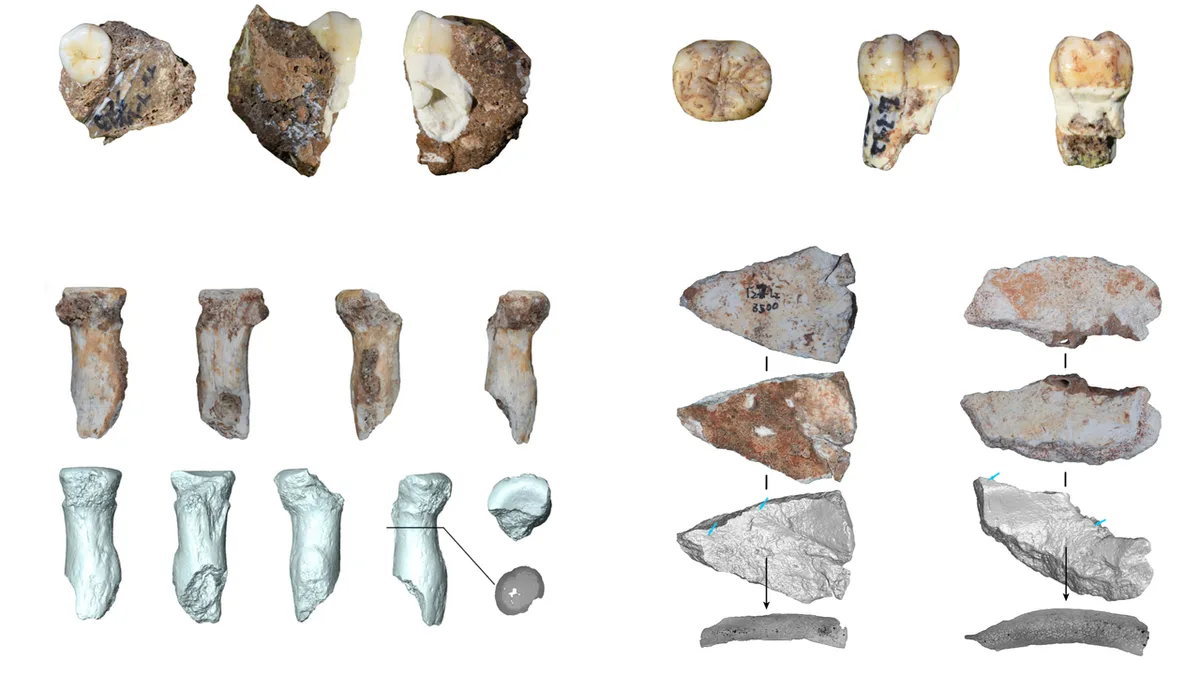
Animal bones and ancient tools revealed that the cave was used from 190,000 to 70,000 years ago, and five human fossils dating to between 134,000 and 167,000 years ago confirmed that the people who used the cave were Denisovans.
Bianfu Cave is in the Yunnan province of southwestern China.
In 2019, archaeologists excavated several stratigraphic layers of the cave and discovered nearly 1,400 stone artifacts, more than 64,000 mammal bones, and four teeth from an unknown human lineage.
The Yunnan area is where Denisovans and modern humans are known to have met and mated , so researchers were unsure which group had used tools to butcher animals inside Bianfu Cave.
The geographical location of the Bianfu Cave, where researchers have discovered several teeth and bones from Denisovans. (Image credit: Institute of Vertebrate Paleontology and Paleoanthropology of China) In one study, a research team used a technique called zooarchaeology by mass spectrometry ( ZooMS ) to quickly and efficiently screen the bone fragments from Bianfu Cave.
ZooMS is a form of protein analysis that involves extracting collagen from the bones of an unknown species and comparing the protein pattern to the unique "fingerprint" of reference animals.
5News aggregated this summary from the outlet’s public feed. The full article, with all the context, is on www.livescience.com — the content belongs to Live Science.