An ancient 'supervolcano' has been found hiding beneath eastern England. But experts say there's not enough evidence to call it that.
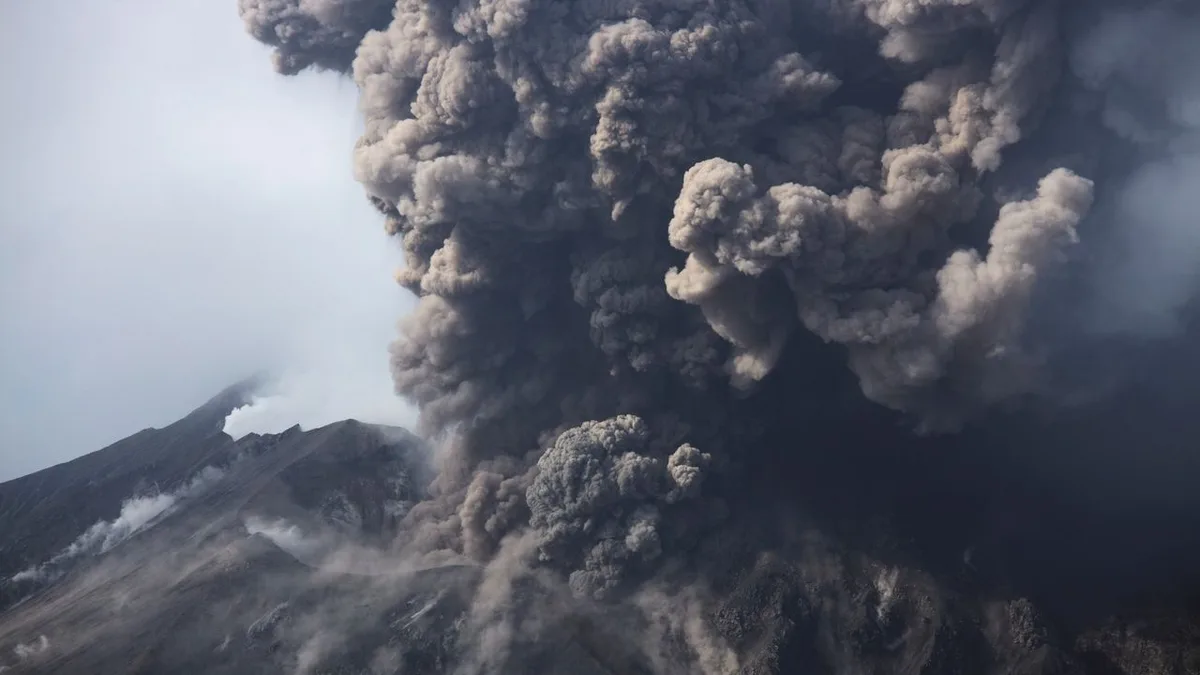
Scientists have identified an ancient volcano on England's east coast that is so eroded, it took researchers three decades to piece together its enormous size and explosive past.
What remains of the caldera system is located beneath the English counties of Norfolk and Lincolnshire.
However, while the volcano undoubtedly produced at least one huge-scale eruption, some experts don't think there is enough evidence for the structure to be called a supervolcano .
"It obviously must have been a very large eruption, but it would be very difficult to calculate the volume of the eruption given the poor preservation of the deposits," said Michael Poland , a research geophysicist with the Cascades Volcano Observatory and the scientist-in-charge of the Yellowstone Volcano Observatory.
"This is part of the reason I really hate the term 'supervolcano,'" Poland, who was not involved in the discovery, told Live Science in an email.
In a recent analysis, published April 29 in the Geological Society of America Bulletin , scientists examined zircon crystals that were taken 80 years ago from boreholes 40 miles (65 kilometers) apart in Norfolk and Lincolnshire.
Zircon crystals are smaller than the diameter of a human hair and form within molten magma underground before a volcano erupts.
They contain uranium that decays into lead isotopes at a known rate, enabling researchers to precisely date eruptions.
The results showed an age match between the zircon crystals from Norfolk and Lincolnshire and counterparts taken from the Kinnekulle tephra, a thick layer of volcanic ash covering Scandinavia and the Baltic region.
This suggests the ash plume from the volcano in what is now eastern England blew across the Tornquist Sea, a body of water that existed during the Ordovician period (488.3 million to 443.7 million years ago), and settled on what is now Scandinavia.
The Kinnekulle tephra is visible next to train track north of Oslo in Norway.
Dipping strata of the Arnestad Formation (Late Ordovician) contain thin beds of gray-green altered volcanic ash. (Image credit: © Tim Pharaoh) Researchers already knew that the Kinnekulle tephra was formed during a massive volcanic eruption.
But the recent analysis shows for the first time how far the ash traveled and, therefore, how big the eruption really was.
The eruption would have also produced huge pyroclastic flows, or avalanches of rocky debris, ash and hot gas that race down the sides of some erupting volcanoes, Peter Rowley , a volcanologist and senior lecturer at the University of Bristol in the U.K. who was not involved in the analysis.
5News aggregated this summary from the outlet’s public feed. The full article, with all the context, is on www.livescience.com — the content belongs to Live Science.