The moon may have formed in just 5 hours, new simulations suggest
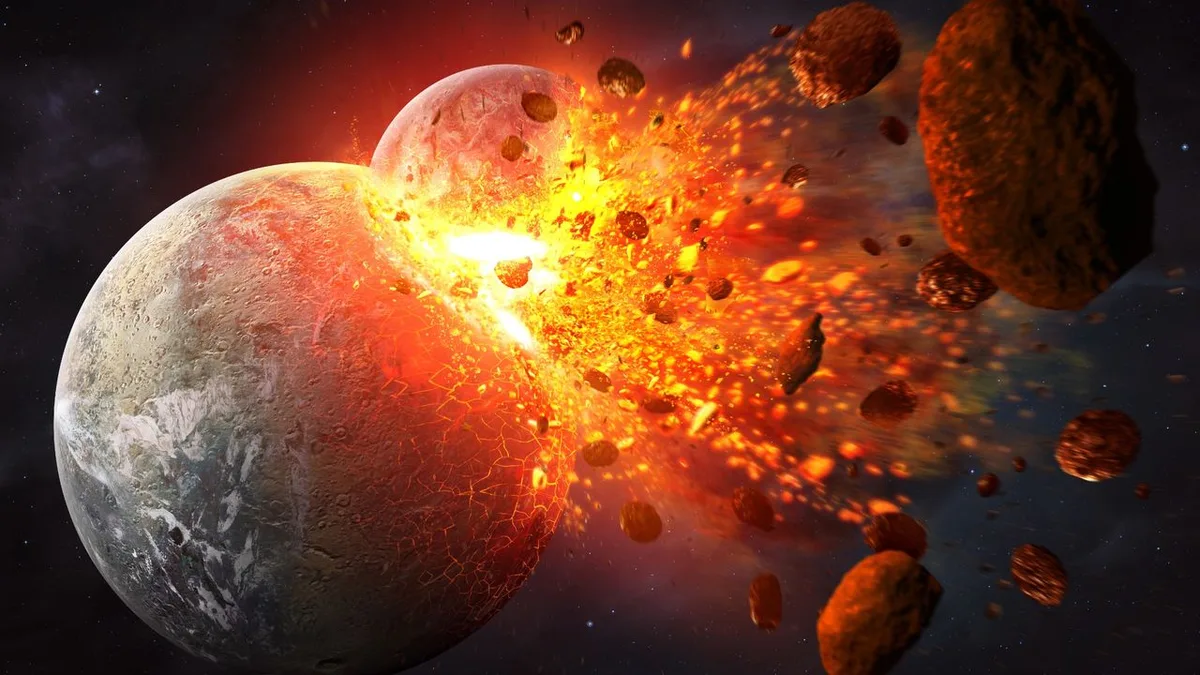
The moon may have formed in as few as five hours after the cataclysmic collision between Earth and a long-lost protoplanet, new simulations suggest.
The surprising findings could help shed light on other historic impacts throughout our cosmic neighborhood and beyond.
Experts strongly suspect that the moon was created when a Mars-size space rock called Theia smashed into an early version of our planet, back when the solar system was young and extremely unstable .
This colossal impact likely would have turned the once-neighboring worlds into spinning clumps of molten rock that eventually coalesced and cooled into the versions of Earth and the moon we see today.
Without this collision, which also may have left chunks of Theia buried deep within our planet , many scientists think that life may have never existed on Earth .
Lunar rocks collected during NASA's Apollo missions have provided evidence to support this theory, dubbed the giant impact hypothesis.
These samples also tell us that the moon is around 4.5 billion years old , meaning the collision occurred roughly 100 million years after the sun was born.
But although scientists have previously simulated the impact event , it has been tricky to ascertain exactly how the moon formed and how long it took to emerge after the Earth-Theia collision.
In the new study, published Sept.
1 in The Astrophysical Journal Letters , researchers conducted a series of simulations focusing on the varying potential geological properties of both Earth and Theia prior to their collision.
This factor has been relatively understudied until now.
"When you simulate the Earth and the moon as colliding bodies with [different] geologic properties, it changes how the moon forms out of that impact — that's something we considered unnecessary before," study first author Adeene Denton , a geologist and planetary scientist at the Southwest Research Institute in Boulder, Colorado, said in a statement .
Researchers simulated the ancient collision between Earth and Theia using a range of different geological properties and found that, with the right conditions, the moon could take shape in a matter of hours. (Image credit: Courtesy of SwRI) Until now, simulations of the Earth-Theia impact have focused mainly on the masses of the colliding neighbors.
But in the new study, the researchers were most interested in the material strength of the two bodies, particularly the hardness of their exteriors.
5News aggregated this summary from the outlet’s public feed. The full article, with all the context, is on www.livescience.com — the content belongs to Live Science.