ZWO Seestar S50 Pro smart telescope review
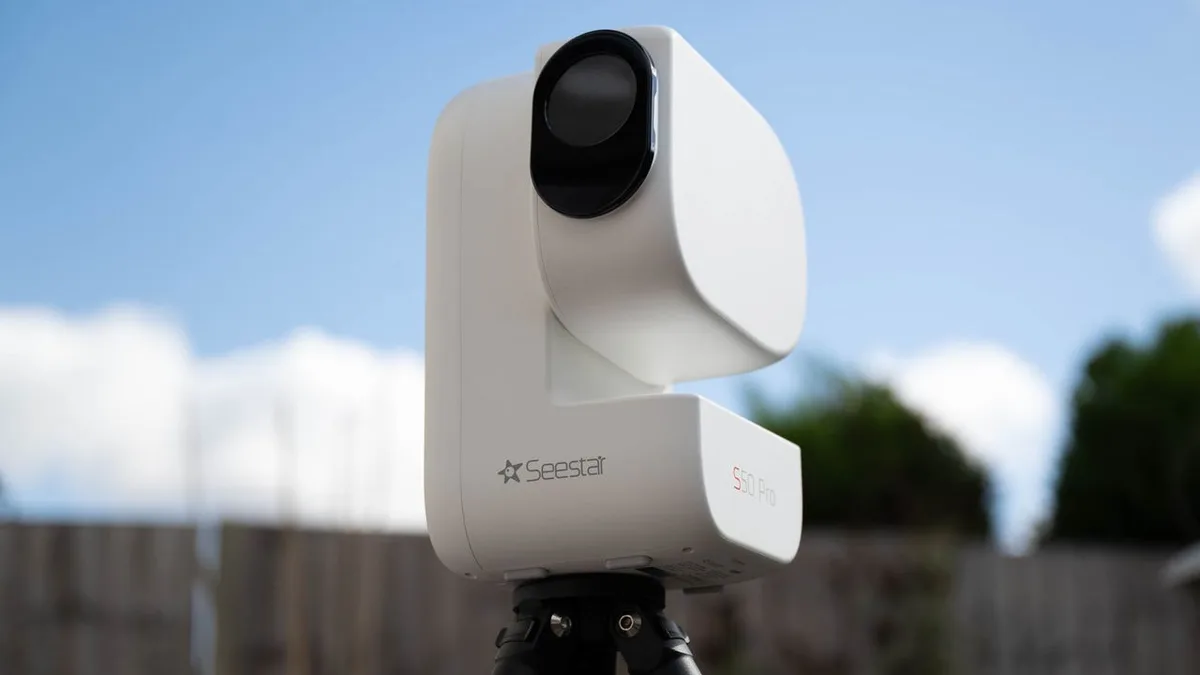
The ZWO Seestar S50 Pro was released on Aug.
25, 2026.
It's a smart telescope that ships with everything you need to get started with astronomy and solar observations, eliminating the need to buy any other accessories.
It is controlled through the Seestar app on a smartphone and offers automatic slewing and autofocused views of galaxies, nebulas, star clusters and more.
That said, in our experience, it sometimes needs manual adjustment with the on-screen joystick to perfect centering.
This being the Pro version of the original S50, which released three years prior, it's more expensive; you'll be paying $450 more than the original S50, with the S50 Pro coming in at $999.
For that you get double the storage capacity (128 GB instead of 64 GB) and a higher resolution (4K not Full HD).
ZWO claims the Pro has an extended battery life of nine hours, though we can't test this yet because the app version responsible for this uplift from the originally stated seven hours (version 3.3.1) wasn't released during testing.
So are these upgrades enough to warrant the extra spend? ZWO Seestar S50 Pro review ZWO Seestar S50 Pro: Design The Seestar S50 Pro comes in white with a compact mini carbon fiber tripod.
Jase Parnell-Brookes Only two buttons feature on the telescope itself, a large power button and a smaller reset button underneath.
Jase Parnell-Brookes A dual lens system mirrors the S30 Pro's design and even has the same resolution.
Jase Parnell-Brookes Lightweight and easy to carry in the case provided Dual-lens system mirrors the S30 Pro Simple, two-button design and an easy push-on solar filter The Seestar S50 Pro is instantly recognizable as a smart telescope.
A neat, rounded and glossy plastic casing protects the fragile but automatic optical and electrical insides that power this pocket rocket.
Only two buttons are found on the entire device: a large power button on the side enveloped by a ring of light that glows when powered on, and a small reset button on the bottom of the telescope.
5News aggregated this summary from the outlet’s public feed. The full article, with all the context, is on www.livescience.com — the content belongs to Live Science.