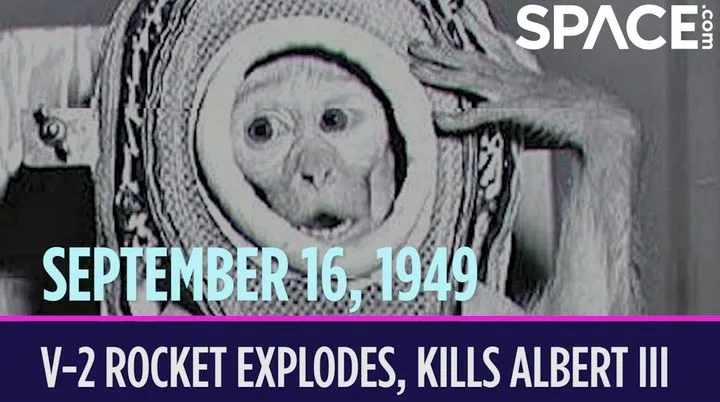
On this day in space! Sept. 16, 1949: A US launch of a V-2 rocket explodes, killing its monkey passenger Albert III
On Sept.
16, 1949, the U.S. launched a V-2 rocket with a monkey named Albert III on board.
Albert III was the third monkey the U.S. attempted to launch to space.
He was also the third one to be killed on the job.
The U.S. precursor to NASA began launching monkeys into space in the 1940s to try to see what might happen to humans in space.
This testing started more than a decade before any humans were launched up there.
The monkeys were all given anesthetics and covered with sensors and probes that monitored their vitals.
While the other five Alberts that were launched on V-2 rockets were all rhesus monkeys, Albert III was actually a long-tailed macaque.
Sadly, Albert III died when his rocket exploded 10 seconds after launch.
The two Alberts who came before him died differently, first by suffocation and then by a parachute that failed to deploy before landing.
It wasn't until the Albert VI flew in 1961 that a test monkey survived a test launch.
NASA stopped using monkeys for launch testing in the 1980s.
A small macaque monkey named Albert III was lost during a failed V-2 rocket launch test from White Sands Missile Range in New Mexico on Sept.
16, 1949. (Image credit: Future/NASA) Why it mattered In the late 1940s, the United States was just beginning to gain experience with large rocket and ballistic missile launches using a cache of V-2 rockets (and the German rocket scientists like Werhner von Braun that designed them).
5News aggregated this summary from the outlet’s public feed. The full article, with all the context, is on www.space.com — the content belongs to Space.com.