Could comet 3I/ATLAS teach us about life beyond Earth? Scientists say the story's not over yet.
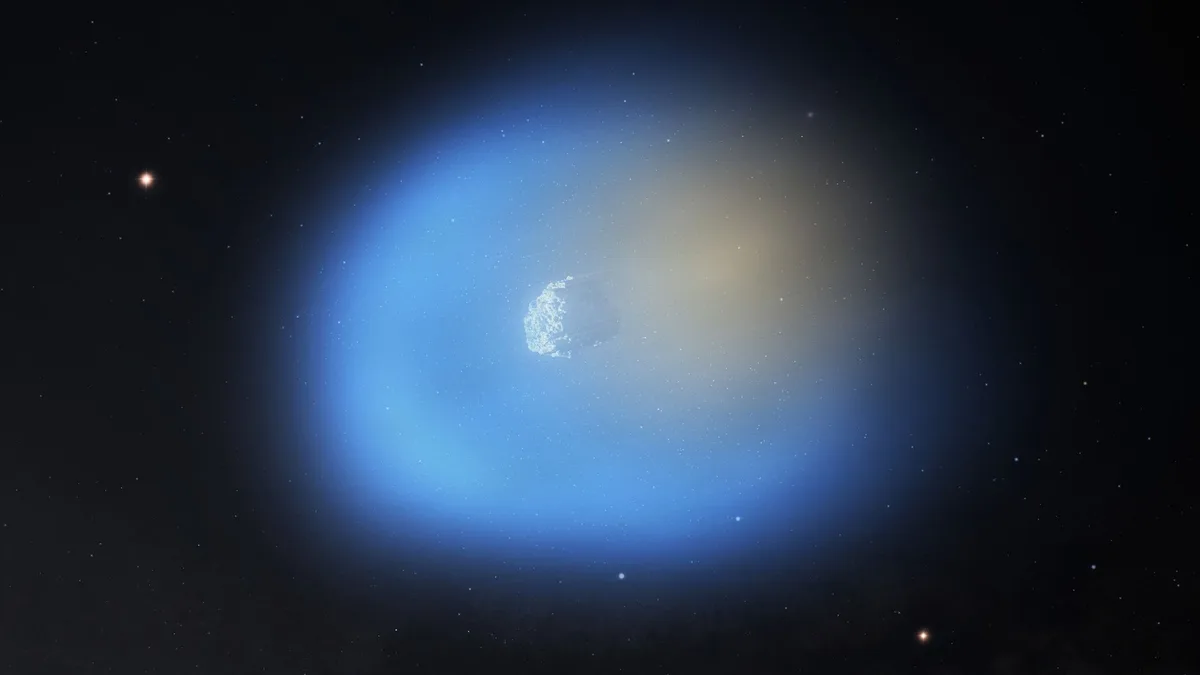
In July 2025, a large, bright cosmic object visited from beyond our solar system.
Only the third interstellar object ever discovered, the comet — named 3I/ATLAS — swooped through the inner solar system for about four months , briefly making it one of the biggest science celebrities in the world.
The interstellar object's fame stemmed in large part from controversial (and unsubstantiated) claims that it could be a source of intelligent alien technology , even though 3I/ATLAS behaved like a natural comet.
However, according to the astronomers who are studying its mysteries in the data collected by dozens of telescopes and spacecraft, the ancient object may still have lessons to teach us about life in the cosmos.
3I/ATLAS is likely a preserved fragment of a planetesimal — a building block of a planet — from a distant system, Martin Cordiner , a researcher in astrochemistry and planetary science at NASA's Goddard Space Flight Center, told Live Science.
Therefore, the comet's composition could offer clues to the prevalence of life's building blocks around distant stars.
Some astronomers even hope this cosmic interloper will help constrain how likely life is elsewhere in our galaxy.
Blast from the past Comets like 3I/ATLAS are important because scientists think they help "seed" planets with carbon-containing chemicals, Darryl Seligman , an assistant professor of astronomy at Michigan State University, told Live Science in an email.
Some of these chemicals, like methanol, have simple structures.
Others, like amino acids, are more complex.
Together, these carbon-containing, or organic, compounds form the basis for biomolecules, like proteins and nucleic acids, that interact to produce life.
Samples returned from space rocks in our neighborhood strongly support the idea that they transported such molecules within the solar system.
For instance, fragments from the solar system asteroid Bennu obtained during NASA's OSIRIS-REx mission contain all five nucleotide bases , the building blocks of nucleic acids.
Matthew Belyakov , a postdoctoral researcher in planetary science at Caltech, noted that the Bennu samples also contained 14 of the 20 amino acids that form naturally on Earth.
5News aggregated this summary from the outlet’s public feed. The full article, with all the context, is on www.livescience.com — the content belongs to Live Science.