The Supreme Court’s about to face an entirely new kind of voter discrimination
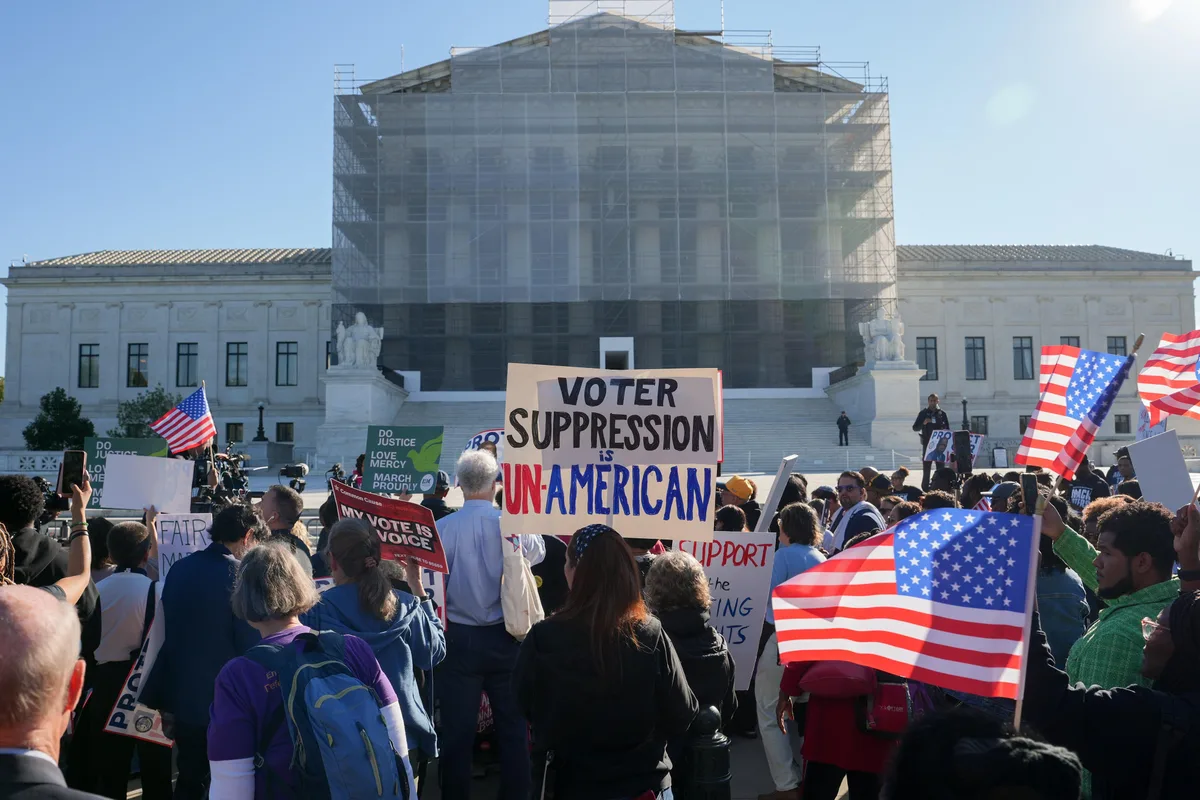
Demonstrators outside the US Supreme Court in Washington, DC, on October 15, 2025. | Eric Lee/Bloomberg via Getty Images On Tuesday, a federal appeals court struck down a South Carolina law that permits all voters over age 65 to vote by mail but allows younger voters to do so only if they meet a set of specific criteria.
The United States Court of Appeals for the Fourth Circuit’s decision in Grant v.
Belangia held that the state’s law violates the 26th Amendment .
If you’re having trouble remembering what the 26th Amendment does, you’re probably not alone.
Ratified in 1971, the 26th Amendment states that “the right of citizens of the United States, who are eighteen years of age or older, to vote shall not be denied or abridged by the United States or by any State on account of age .” As the Fifth Circuit noted in a case challenging a similar Texas law, the amendment “ has yet to be interpreted in any significant depth .” But three different federal appeals courts have now split three ways on how to read it, which makes it likely that the Supreme Court will have to step in soon and determine, for the first time, what a relatively new constitutional amendment actually means.
And if that happens, it will have significant implications for the increasingly partisan war over how difficult it should be to vote by mail.
Key takeaways The Supreme Court has never interpreted the 26th Amendment, which limits age discrimination in voting.
Three courts, however, have now split on whether it allows states to make it easier for older voters — and only older voters — to vote by mail.
This issue has significant partisan stakes because Democrats are more likely than Republicans to vote by mail.
The Fourth Circuit’s opinion in Grant holds that the 26th Amendment prohibits “ unequal allocation of voting access based on age ,” and thus, if elderly voters can vote by mail, younger voters must be allowed to do so as well.
Both the Fifth and the Seventh Circuits, which previously ruled on similar challenges to Texas and Indiana absentee voting laws, disagree with this view.
The question of whether states may have different absentee voting rules for older voters first flared up in 2020, during the Covid-19 pandemic.
Many voters were afraid to go to the polls, for fear that they might become infected if they voted alongside others in an indoor polling place.
And this led to a pair of lawsuits claiming that Texas must allow younger voters to vote absentee, lest they be effectively denied the ability to safely cast a ballot altogether.
5News aggregated this summary from the outlet’s public feed. The full article, with all the context, is on www.vox.com — the content belongs to Vox.