Why this year’s Medicare-for-all debate is different
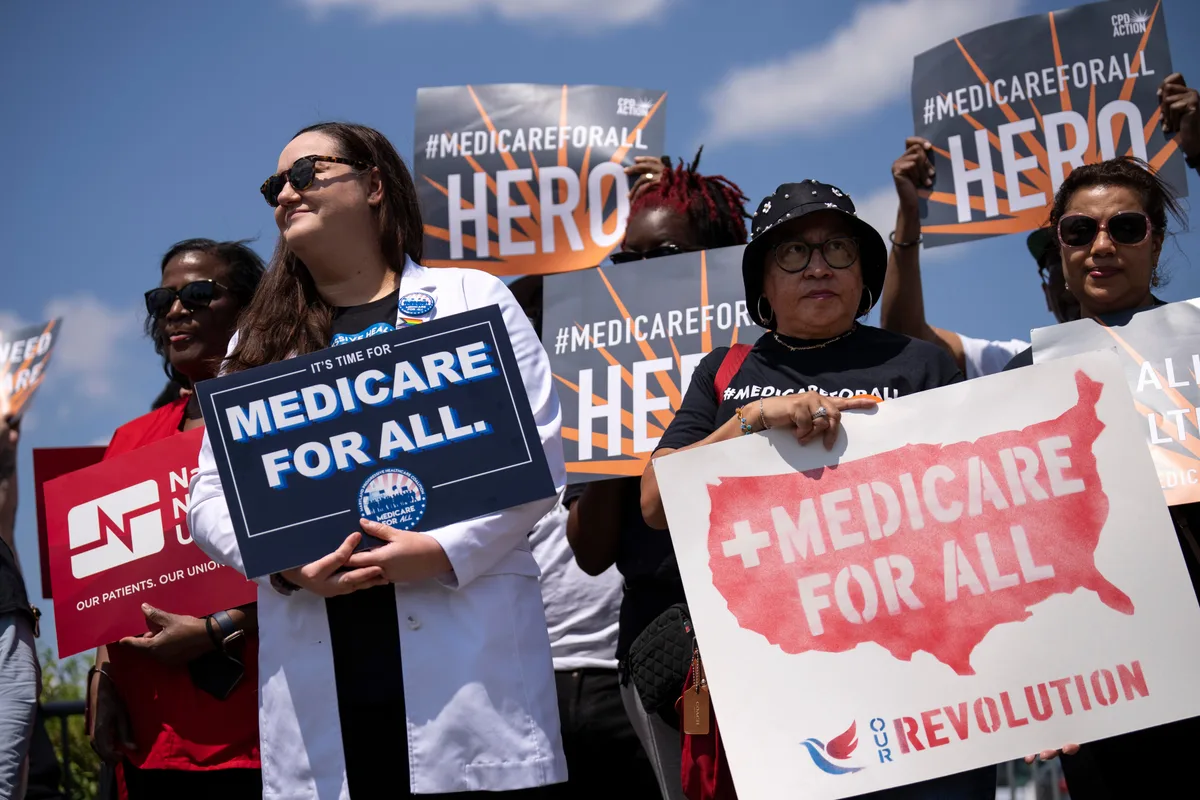
Supporters look on as Sen.
Bernie Sanders (I-VT) speaks during a news conference to announce the re-introduction of the Medicare for All Act of 2023, outside the Capitol on May 17, 2023, in Washington, DC. | Drew Angerer/Getty Images The affordability and availability of healthcare is emerging as a top concern for Americans , with some recent surveys ranking it easily as the top concern.
Voters are upset with rising costs, and federal cuts to Medicaid and Obamacare subsidies threaten to leave millions more uninsured .
Progressive candidates, who have won major primaries this cycle, have been eager to offer Medicare-for-all as a solution.
Polling suggests there is broad support for the idea, even if most American voters aren’t sure what the phrase means in practice.
But Democrats have also been fighting about Medicare-for-all for the last decade, with battles reaching a fever pitch in the 2020 presidential primary .
The popular slogan has been most closely associated with Vermont Senator and two-time presidential candidate Bernie Sanders, whose federal Medicare for All Act would enroll virtually every American into one national plan and largely eliminate private health insurance.
Six years later, plenty of Democrats still remember bitter arguments over whether to replace private insurance or build on it, dividing the party over an issue they otherwise agreed was a top priority.
Key takeaways The health care fight that defined 2020 may not happen again: Abdul El-Sayed, who wrote a book on Medicare-for-all, is running on a version that keeps private insurance — and Sanders and Ocasio-Cortez have endorsed him.
Voters still don’t agree on what Medicare-for-all means: A March 2026 survey found 60 percent think Medicare-for-all would create a single-payer system, while 61 percent also think they’d keep their private plan.
The stakes are rising fast: Health insurers want a median 15 percent premium hike on top of roughly 20 percent this year, and Medicaid work requirements start in January, just as the 2028 campaign begins.
Yet there are emerging signs that the party is not about to experience déjà vu when it comes to healthcare politics.
In interviews over the last few weeks, activists, pollsters, and policy experts sound cautiously optimistic that the Democratic healthcare wars might finally be headed for a collaborative truce.
And Abdul El-Sayed, the buzzy Michigan progressive who wrote a book on Medicare-for-all, is campaigning for US Senate on a version that would let people keep their private health insurance, a potentially major shift.
5News aggregated this summary from the outlet’s public feed. The full article, with all the context, is on www.vox.com — the content belongs to Vox.