Mars may have been losing its water more than 4 billion years ago, oldest-known Martian meteorite suggests
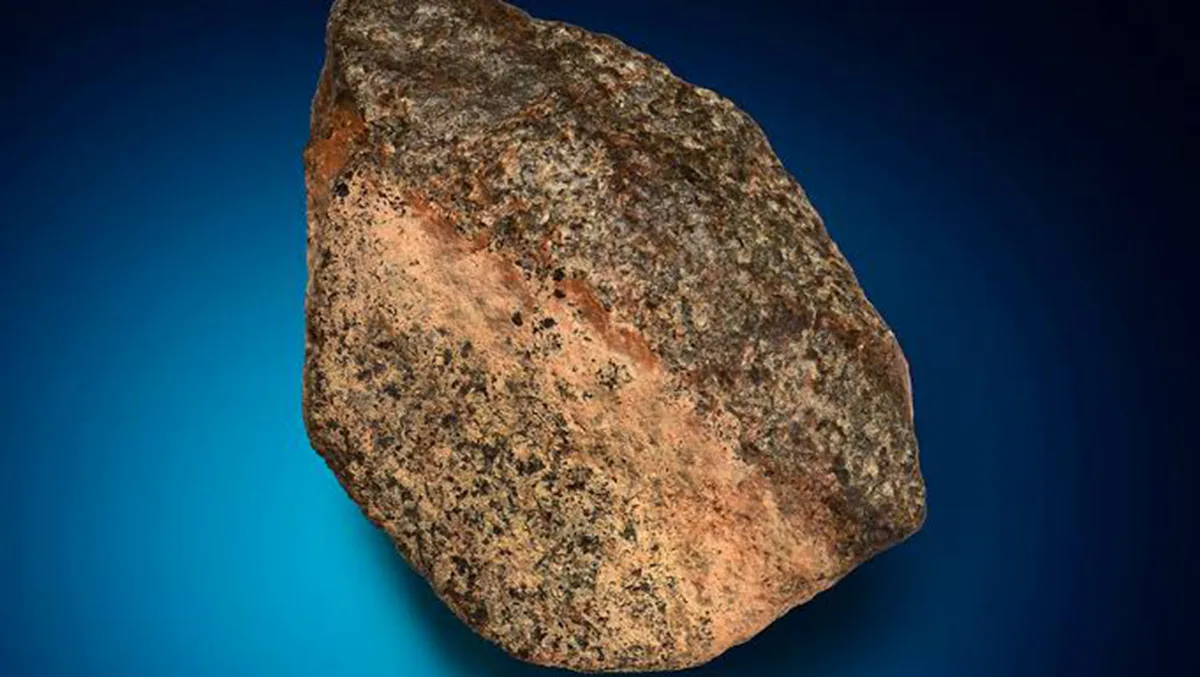
An unassuming, brownish stone may be one of the most precious objects on Earth.
The rare rock, called Teghaza 001, is a piece of ancient Mars and gives geoscientists an invaluable opportunity to study the planet's oldest material.
Now, a slew of recent studies based on evidence from the space rock are helping scientists understand more about the Red Planet's history of habitability.
Scientists believe that Earth and Mars coalesced around 4.5 billion years ago from the protoplanetary disk of gas and dust that surrounded our young sun.
These two celestial siblings have since shared more than a few rocks in the intervening millions of millennia.
Meteoroid impacts frequently gouge the Martian crust and have sent several hundred pieces of Mars hurtling to Earth — a free Mars return mission, paid for by the universe.
Two especially famous specimens include the Allan Hills 84001 meteorite , which contains tantalizing 4 billion-year-old organic molecules; and NWA 7034 , a meteorite with 4.4 billion-year components and specks of ancient water.
But these Martian meteorites are lacking in a couple of respects.
The former lacks mineral variety, and the latter appears to be a meteoritic mosaic that solidified from much older individual components, so neither faithfully represents some of Mars' oldest crust.
Teghaza 001, however, may help fill that knowledge gap.
Martian history right in our hands The Teghaza 001 meteorite comprises 28 ounces (800 grams) of Martian material, split into eight pieces recovered in 2022 near the Taghaza archaeological area in Mali.
It's owned by the Maine Mineral and Gem Museum .
In a preprint uploaded April 14, which has not yet been peer-reviewed, researchers measured the rate of multiple types of radioactive decay in different minerals, including tiny crystals called zircons, which are embedded within Teghaza 001, and found that the multiple measures agreed on an age at least 4.1 billion years ago.
This may make the space rock the single oldest-known piece of Mars.
5News aggregated this summary from the outlet’s public feed. The full article, with all the context, is on www.livescience.com — the content belongs to Live Science.