On this day in space! Sept. 11, 1985: The International Cometary Explorer makes 1st comet flyby in history for NASA and Europe
On Sept.
11, 1985, the International Cometary Explorer, or "ICE," became the first spacecraft to fly by a comet .
Originally launched as the International Sun-Earth Explorer-3 in 1978, ICE was one of three spacecraft built for the International Sun-Earth Explorer (ISEE) program, a joint effort by NASA, the European Space Research Organization and the European Space Agency.
The program's purpose was to study space weather , or the interaction between the Earth's magnetic field and the solar wind.
After completing its original mission, the spacecraft did a maneuver to steer it toward Comet Giacobini-Zinner .
It flew straight through the comet's plasma tail, but it didn't stop there! Six months later, it flew by Halley's Comet , too.
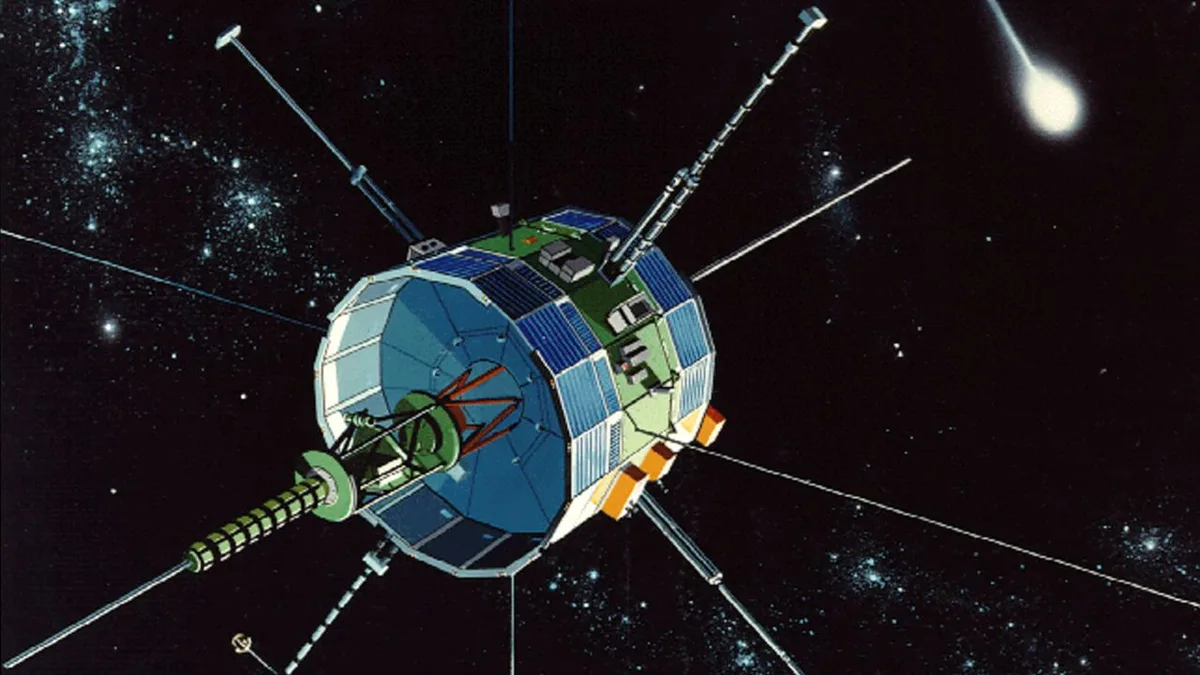
An artist's illustration of NASA and Europe's ISEE-3 (ICE) spacecraft making the first-ever comet flyby on Sept.
11, 2011. (Image credit: NASA) Why it mattered The International Cometary Explorer has gone down in history as a mission of epic firsts, many of which occured after it completed its primary mission.
As mentioned above, NASA, ESA and the European Space Research Organisation teamed up to build and launch the probe in 1978, when it was called the International Sun-Earth Explorer 3, or ISEE-3.
The mission was the third of three to study the sun-Earth environment, with ISEE-3 aimed at studying energetic particles, electric and magnetic fields and the plasma environment.
It carried 14 different instruments, including a solar wind detector and gear to measure cosmic rays , X-rays and gamma rays .
For its primary mission, ISEE-3 flew to the L1 Lagrange point about 1 million miles (1.5 million kilometers) from Earth on the sun-facing side and spent three years conducting science.
It was the first spacecraft ever to orbit a Lagrange (or libration) point, NASA has said .
Comet 21P/Giacobini-Zinner passes by the open star cluster M37 on Sept.
5News aggregated this summary from the outlet’s public feed. The full article, with all the context, is on www.space.com — the content belongs to Space.com.