Her Last Album Has Become One of the Defining Records of the Decade. Her New One Is Something Else Altogether.
Sign up for the Slatest to get the most insightful analysis, criticism, and advice out there, delivered to your inbox daily.
For millennia, women’s voices have borne the burden of lamenting the dead, from the ancient Greek and Egyptian eras through to modernity, across cultures, including in Gaza today . But on “The Outside,” the track that opens Phoebe Bridgers’ return album after an extended bereavement leave from public life, she abjures obvious signs of feminine mourning, the sob or wail many listeners might expect from this supposed “sad girl” songwriter turned improbable pop star. Instead, she deploys a vocoder effect—that war-forged vocal filter with its emotionally and sexually neutered spectrum of drones —to turn herself into her own cybernetic Greek chorus.
These Phoebe-bots step forward in the album’s first moments as if to update the listener on what’s happened offstage between acts. That is, in the long Lost Weekend, as the album title teasingly puts it, of the six-year gap since her second solo album, Punisher , which has become one of the defining records of the decade. Or at least the three years since her side “supergroup” Boygenius put out their own multiple-Grammy-winning album, The Record .
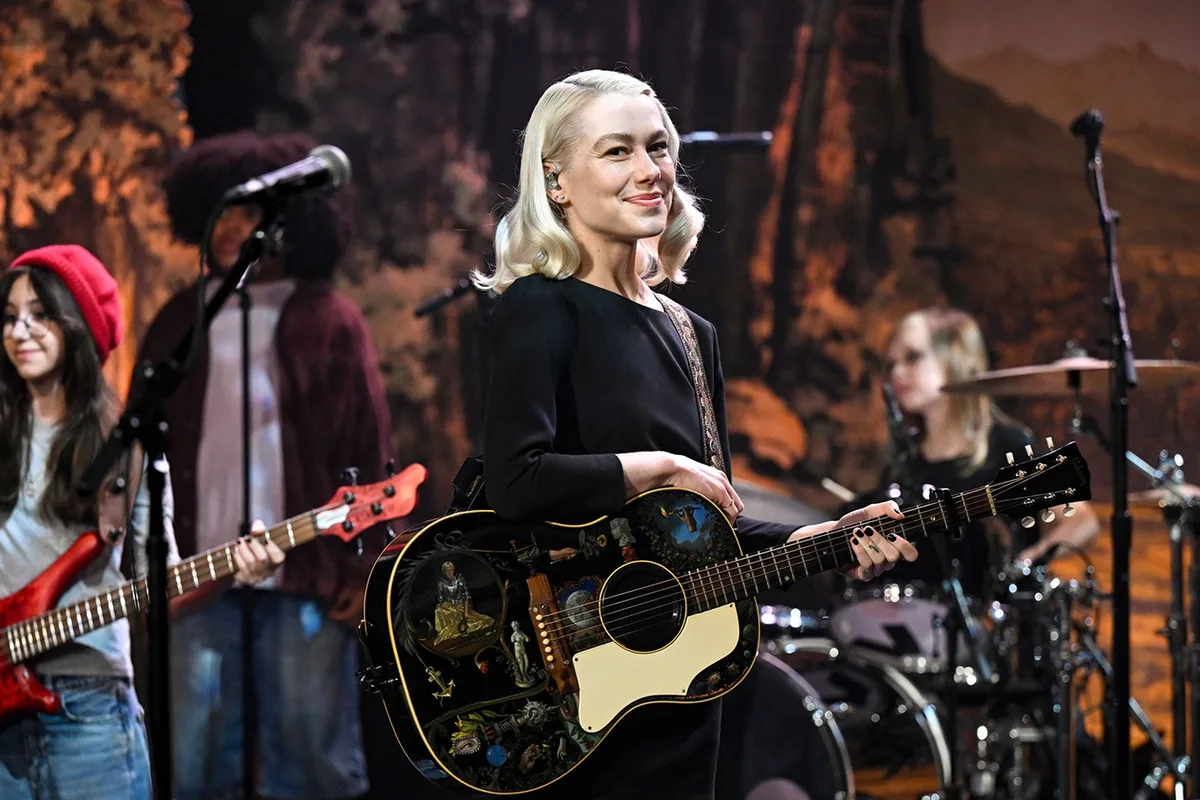
“Crying in a suit and tie,” the vocoder narrates, calling to mind outfits fans are familiar with from Bridgers’ stage-wear and photo shoots , but also classic funeral garb. Then comes the trademark punch line: “But you should see the other guy.” Yeah, the one in the coffin probably got the worst of it. Mourning can be just the latest stage in a long combat. “One more time, for old time’s sake / I’ll watch him get carried away.” The deceased here is surely her father, who died in late 2022, and to whom the album is dedicated. His issues and parental shortcomings have been a subject of earlier songs. (“I’m gonna kill you, if you don’t beat me to it,” she sang at him on Punisher ’s “ Kyoto .”) So the double meaning of “carried away” here hits hard, perhaps as hard as Bridgers apparently drove her “fist through the drywall” in her grief.
But then the voice switches to what listeners know as her “natural” soprano, and she sings in swelling cadences, “I am on the outside, watching.” That sense of distance and dissociation explains the need for the cyber-vocals, which return in the next verse to relate the memory of another ritual—stage-diving into the crowd at one of her own shows, letting fans prop her up, a third kind of being “carried away.” Her dad was there to see it. Still, she repeats, shifting back to the smaller human voice, “I was on the outside, watching.”
In those first minutes, Bridgers, who turns 32 next week, sets up a lot of what she faced with this album. Lost Weekend is a record about grief that thankfully will also turn out to be one about new love, two forces that can overwhelm the senses and bring on expressive excess or stunned speechlessness. It’s a work that comes out of that funny, unnamable, Beckettian feeling, “I can’t go on, I’ll go on.”
Beyond the upheavals in her life, a prime hurdle was her own success.
5News aggregated this summary from the outlet’s public feed. The full article, with all the context, is on slate.com — the content belongs to Slate.